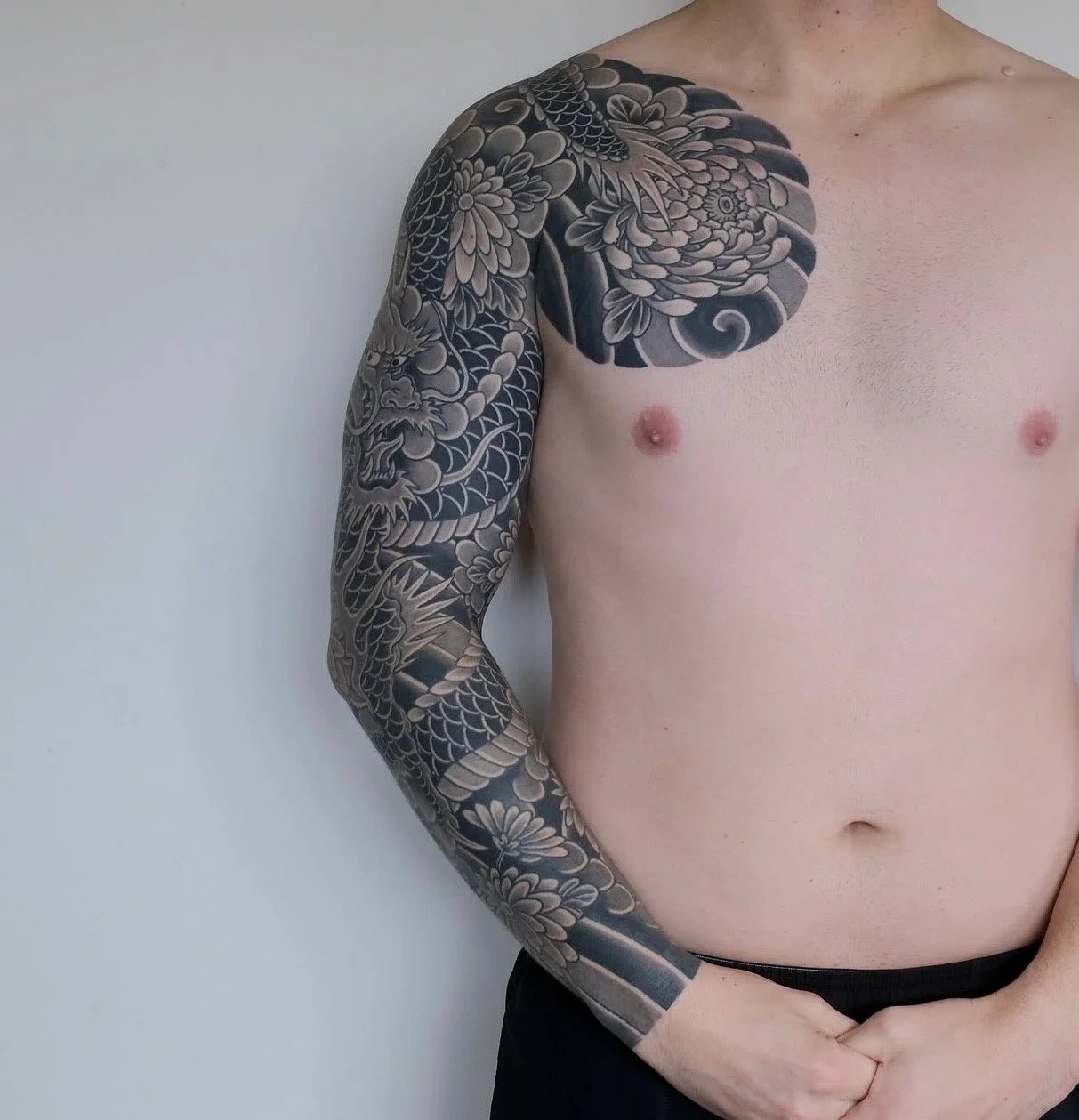
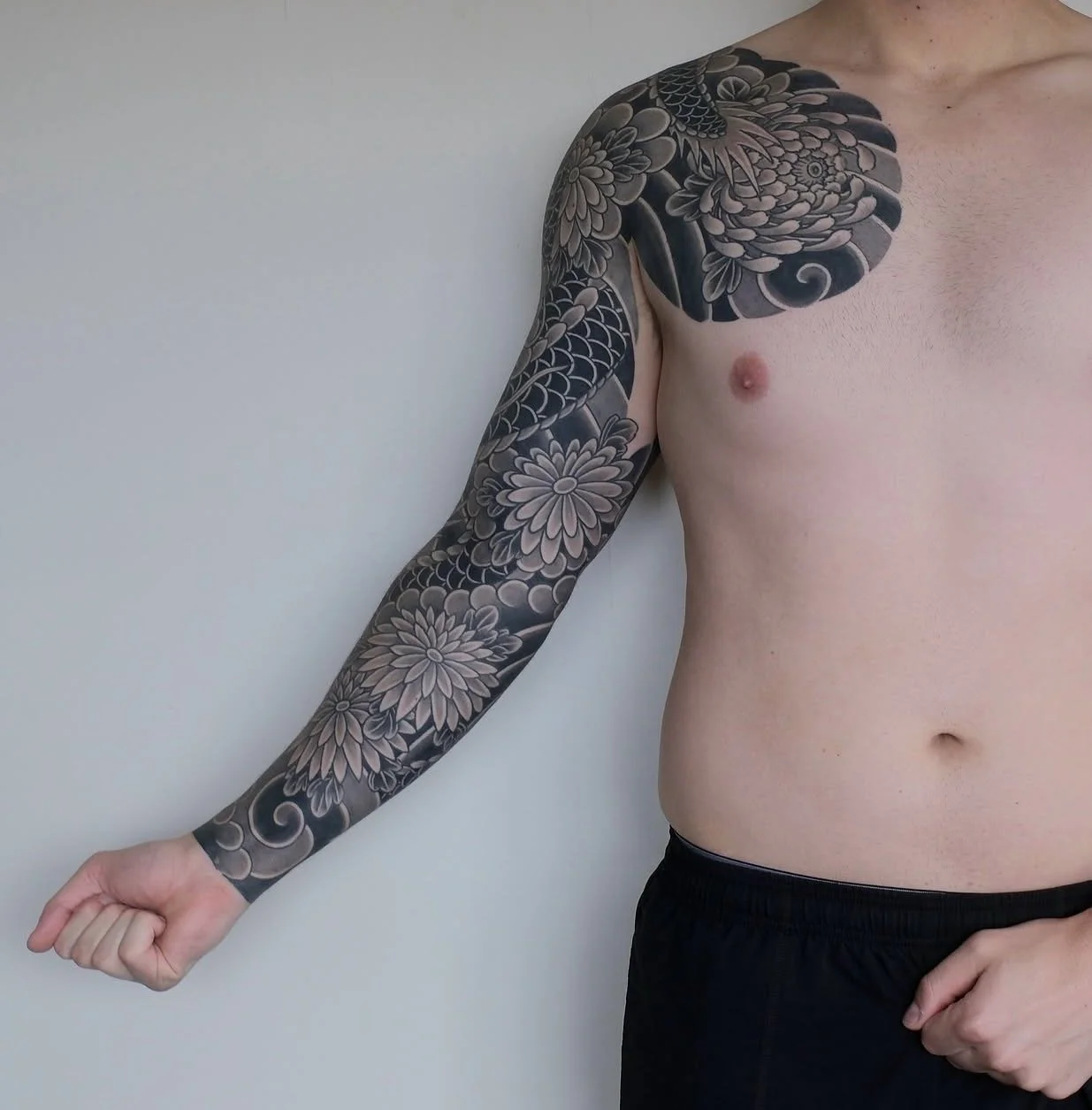
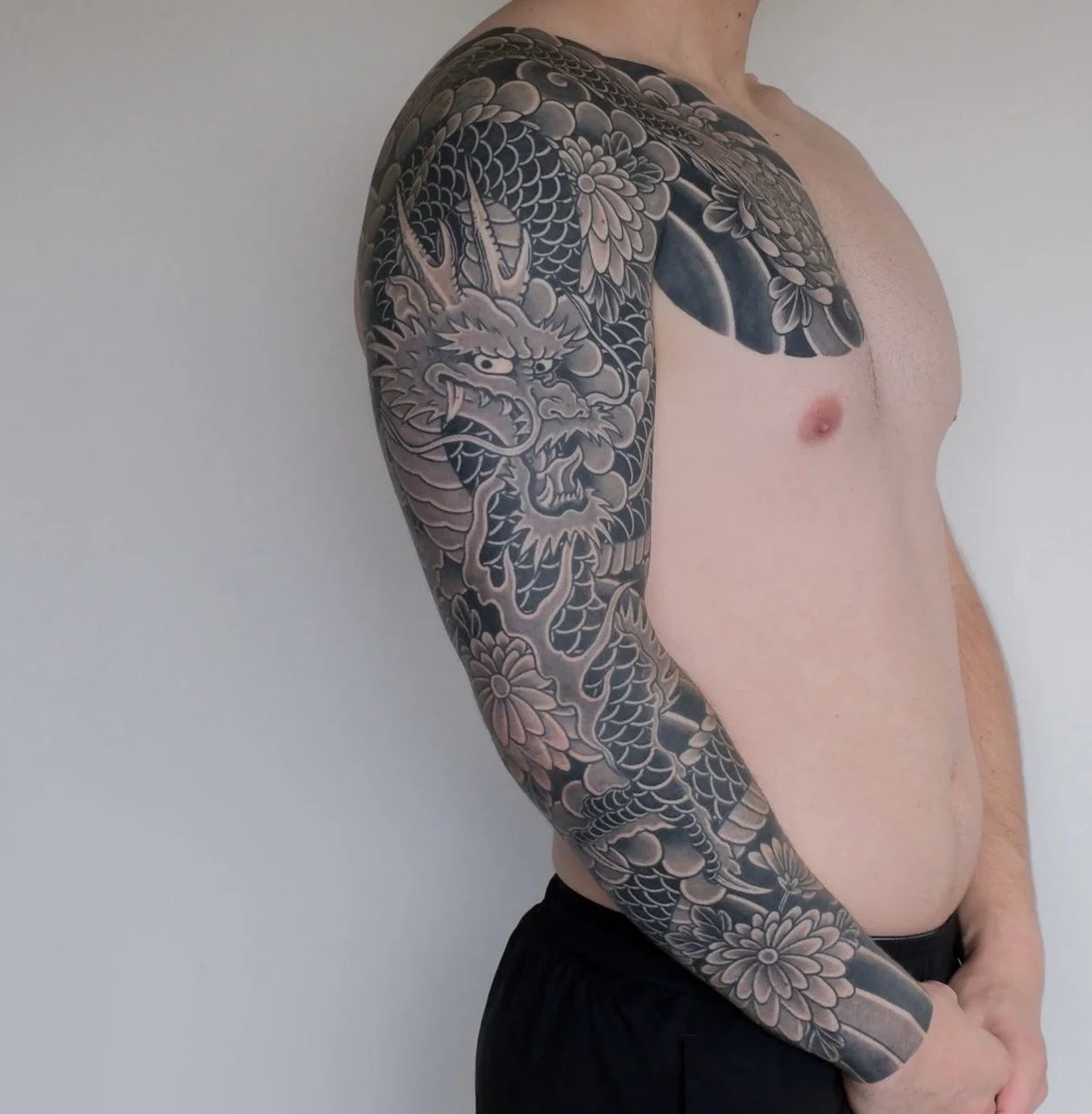
Black and Grey Dragon and Chrysanthemum Sleeve
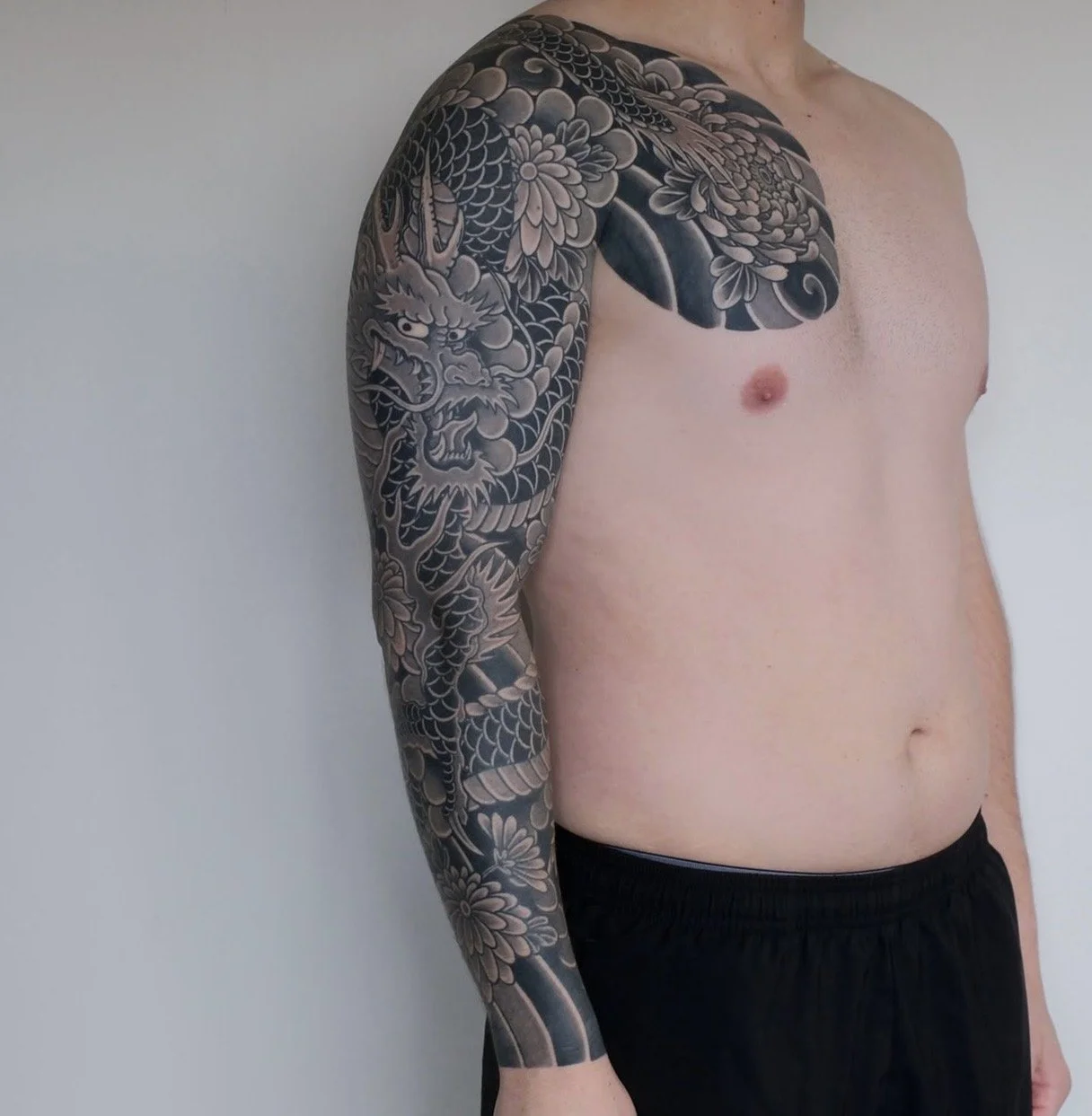
Jack travelled up from Dunedin to get this sleeve done, and I'm really happy with how it turned out. It's a Japanese dragon and chrysanthemum full arm sleeve in black and grey, running from the wrist up to a chest panel.
The dragon's long body wraps the arm and moves with it, so the piece looks different from every angle. The chrysanthemums balance it out. Where the dragon is all power and detail, the flowers bring softness and rhythm, and the big bloom on the chest ties the sleeve back to the body.
A Japanese sleeve doesn't need a complicated main subject. Sometimes people think they need a crowded scene with lots going on, but a well executed sleeve with just one or two elements is perfect. Here it's a dragon and a flower. The impact comes from how they're placed and how they flow together, and from the background, shading and solid black that pull everything into one piece.
Working in black and grey lets the shading do the talking. Smooth gradients fade from solid black into lighter tones, giving the waves, clouds and scales their depth. The background flow holds it all together and lets the sleeve finish cleanly at the wrist.
Jack came a long way for this, and I don't take that lightly. Thanks Jack, it was a pleasure!
Thinking about a Japanese sleeve of your own? Whether you've got a clear idea or just one element you love, get in touch with me and book a consultation, and we'll work through the design together,
An Update on Andrew's Irezumi
I wanted to share a bit of an update on the work I've been doing with Andrew, because it's shaping up to be one of my favourite bodies of work in the studio at the moment. Andrew's been coming in consistently, and between us we've now got a full Raijin sleeve finished, a full dragon back piece completed, and a Fujin sleeve fully lined and ready to move into colour. It's the kind of long-term project I love; proper traditional Japanese work, built up piece by piece, session by session.
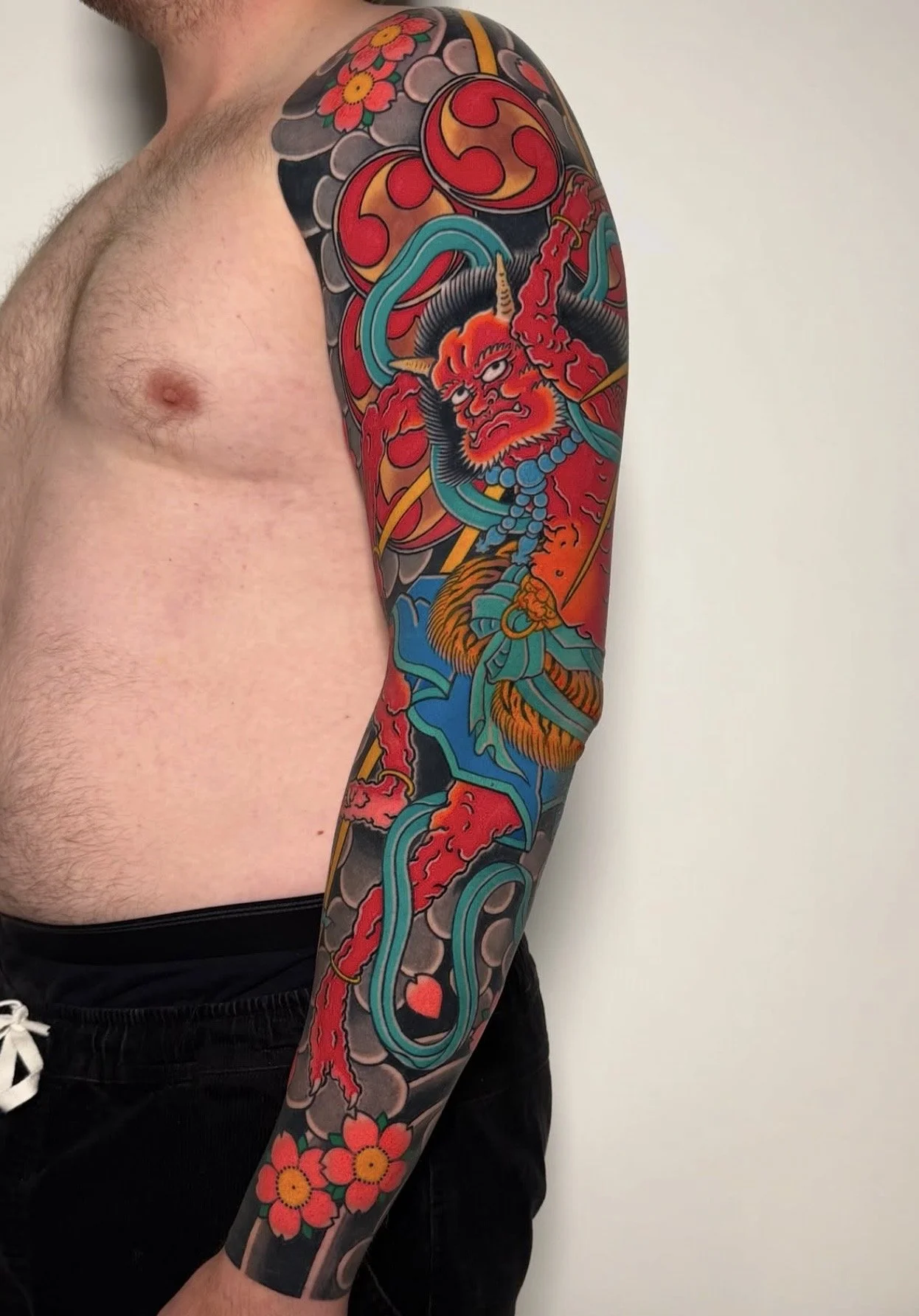
We have just completed the Raijin sleeve and I'm really happy with how it's come together. Raijin, the god of thunder, storms, and lightning, is one of the great subjects in Japanese tattooing. a fierce red figure, usually shown encircled by drums, full of energy and movement. I wanted this sleeve to carry that same intensity, so I've wrapped the figure in teal ribbon, framed him with tomoe crests and grey cloud work, and bordered the whole piece top and bottom with cherry blossom. The colour is vivid but still sits within the traditional structure, a proper full sleeve, built to hold up over time.
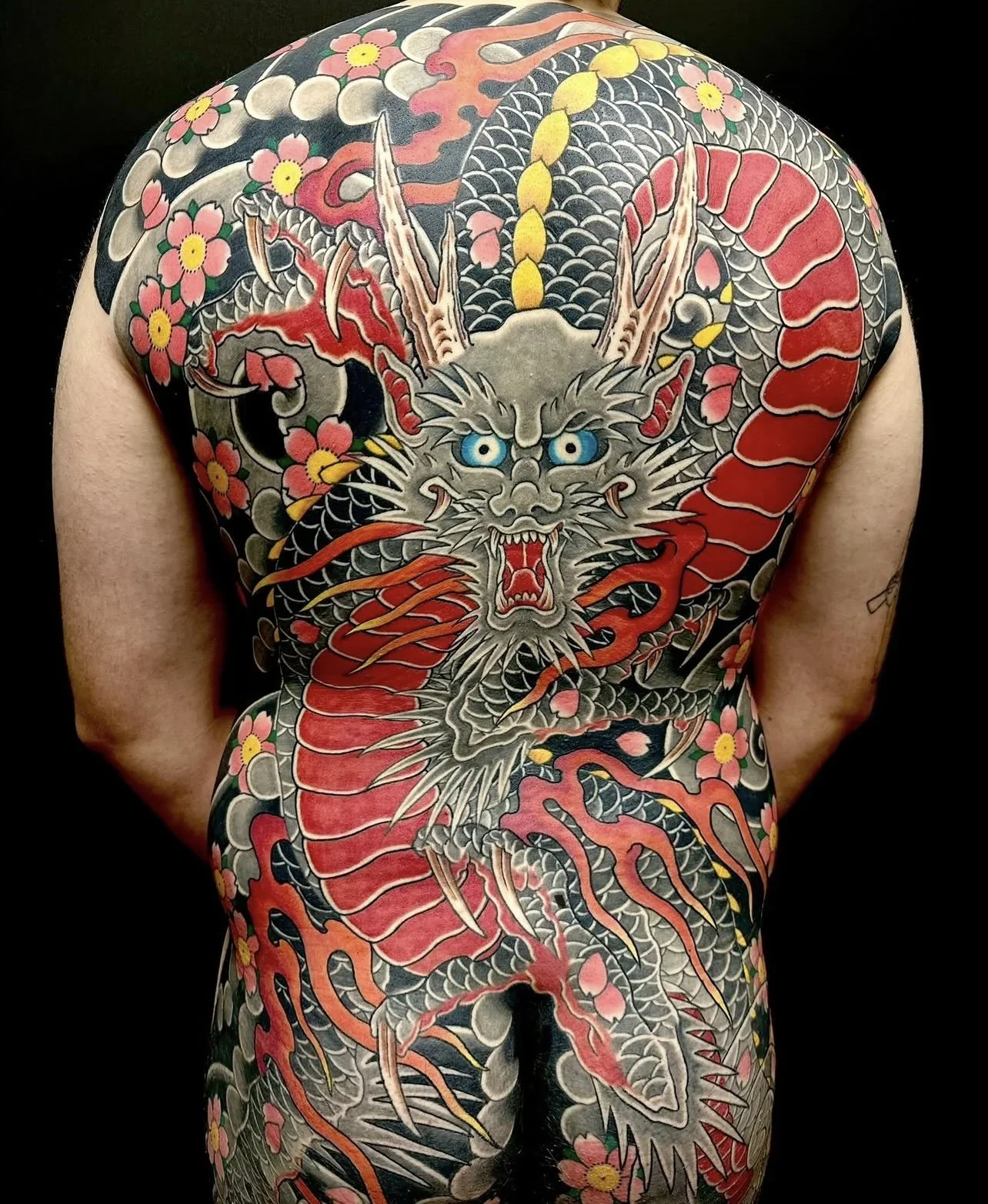
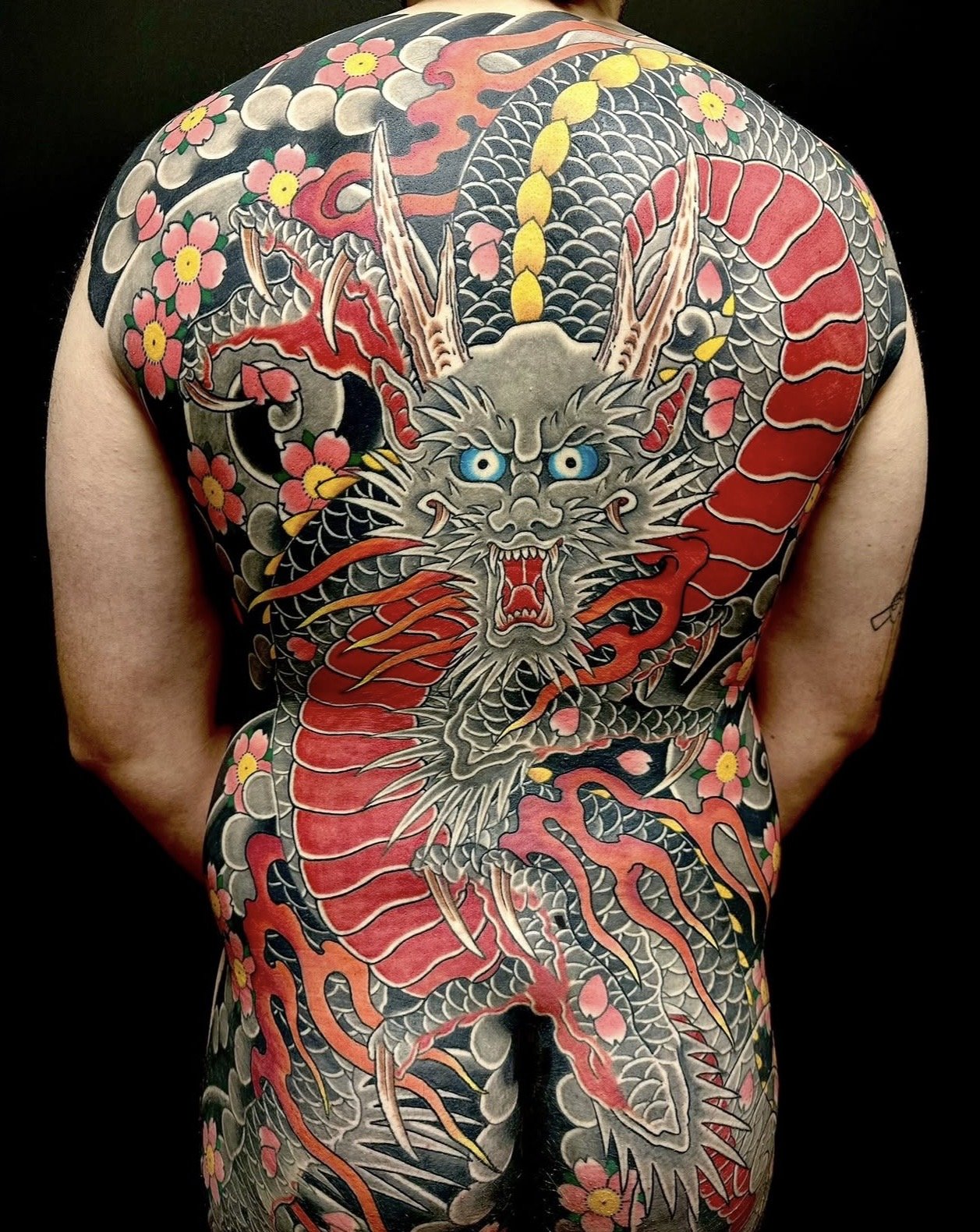
Alongside the sleeve, I've also taken Andrew's back piece through to completion; a black and grey dragon with bursts of red flame and yellow highlight, set against classic scale and cloud work with cherry blossom scattered through it. Dragons are one of the cornerstones of this style, and they've always represented strength, wisdom, and protection. I wanted this piece to have real presence across the whole back, and I think it gets there.
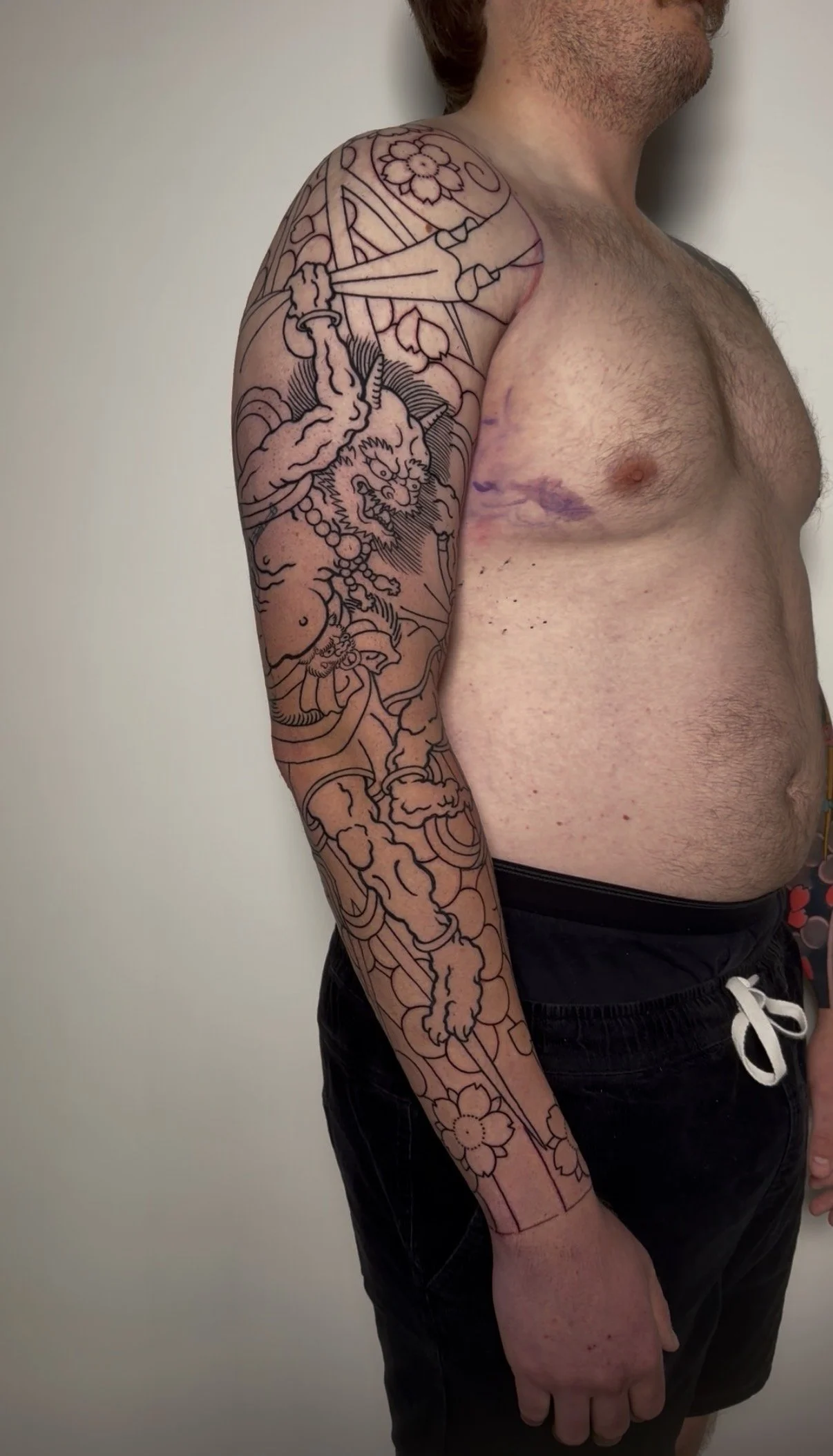
Next up in Andrew's project is a sleeve for Fujin, the wind god, and Raijin's traditional counterpart. I've just finished the lining on this one; the full composition is mapped out, from the cloud work and drum details through to the cherry blossom borders and it's ready to move into colour next. I always enjoy this stage of a project; it's where the bones of the composition and the line work really get to speak for themselves before the colour goes in.
Andrew's project is a great example of what I love about building out a full body of traditional Japanese work over time, each piece speaking to the next, all coming together into something bigger. If you're thinking about starting a similar journey, get in touch and let's talk about it.
Building Jason’s Bodysuit
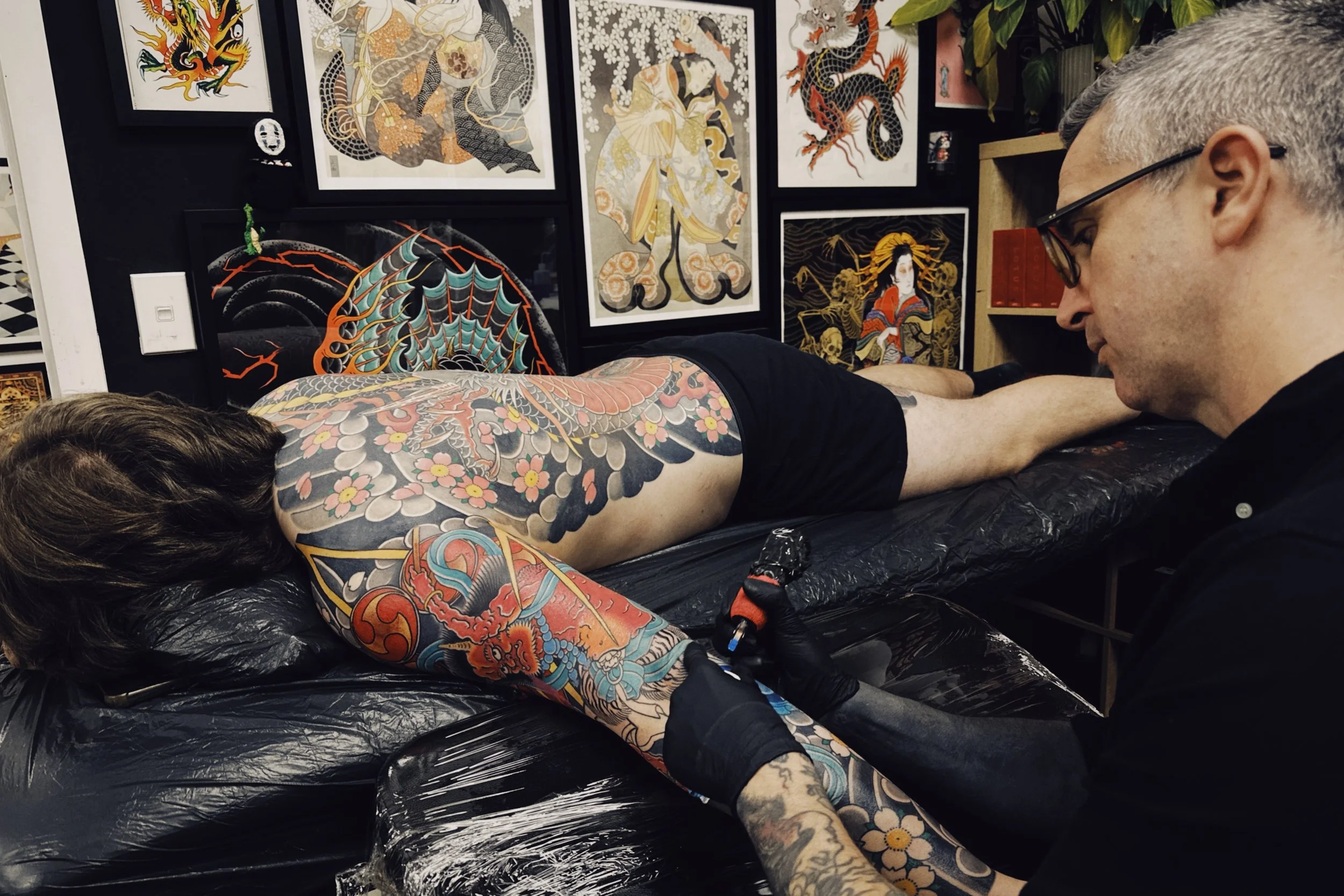
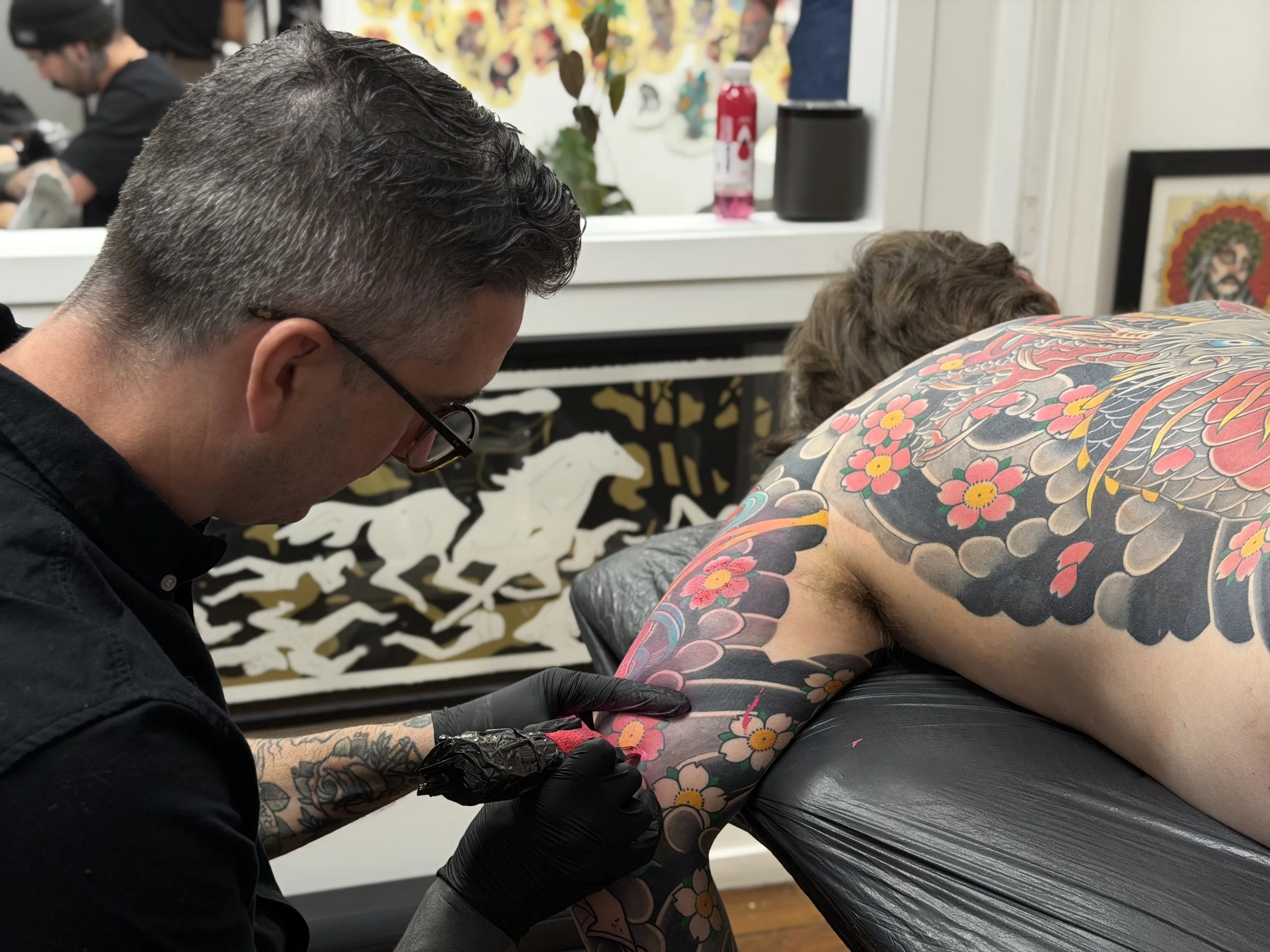
There are projects that come along every so often that remind you why you got into this work in the first place. Jason's bodysuit is one of those for me. Jason came to me already carrying some old 90’s tattoos and rather than covering everything outright, I worked around a lot of what was already there. Using the background to knit the old work into the new and freshening up the old sleeve tattoos so it all reads as one suit rather than a patchwork of decades. A couple of pieces did need full cover ups, but the goal throughout was always the same: make it look like this was the plan from day one, even when it wasn't.
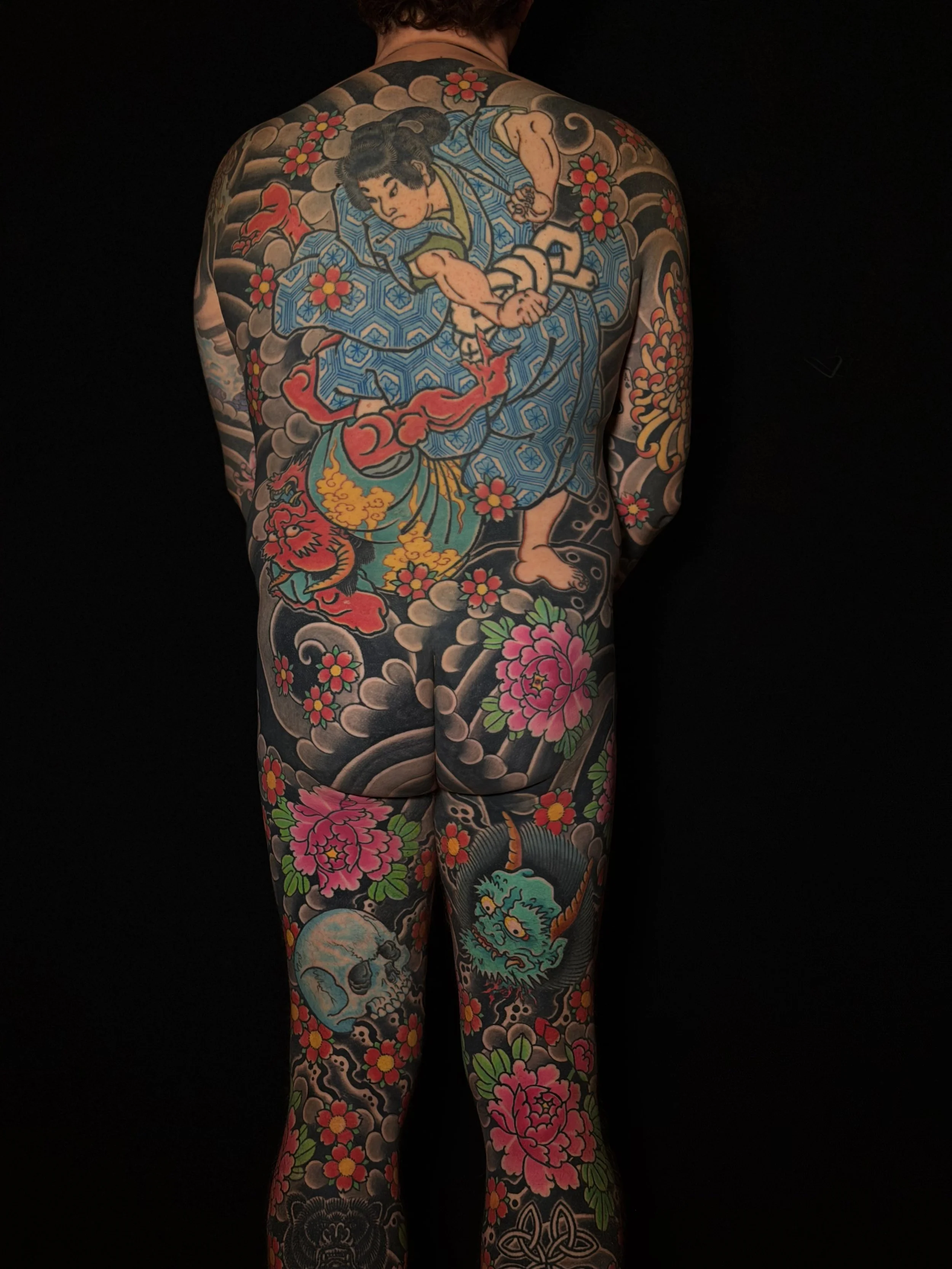
The heart of the whole suit sits on the back: Shiragikumaru, the White Chrysanthemum Boy, taken from a specific Yoshitoshi print; "The Temple Page Shiragikumaru Wrestling a Green Demon," from his 1866 series Sagas of Beauty and Bravery (Biyū Suikoden). The original woodblock shows exactly what it says on the tin: a young man in a floral blue kimono locked in a wrestling hold with a green demon, caught mid-struggle. Shiragikumaru himself is a tragic figure out of Japanese legend; a beautiful boy serving as a page at a Buddhist temple, torn between the priest who loved him and the harassment of the other monks around him. In the old story he and the priest make a suicide pact at Enoshima, each keeping half of an incense box so they'll recognise one another in a future life. It's a story about devotion, tragedy and rebirth all at once, which is a lot of weight to hang on one image, but that's exactly why it works as the anchor for a piece like this.
For Jason's version I kept the drama of the original composition but chose red instead of green to add the the contrast, and to tie it visually into the other guardian figures scattered through the rest of the suit. The acolyte's blue kimono, with its hex-pattern fabric, became the single biggest colour anchor on the whole back, something bold enough to hold its own against a full body of surrounding florals and creatures. It's a scene full of movement and tension, the kind of image that holds a viewer's eye the way a good back piece should.
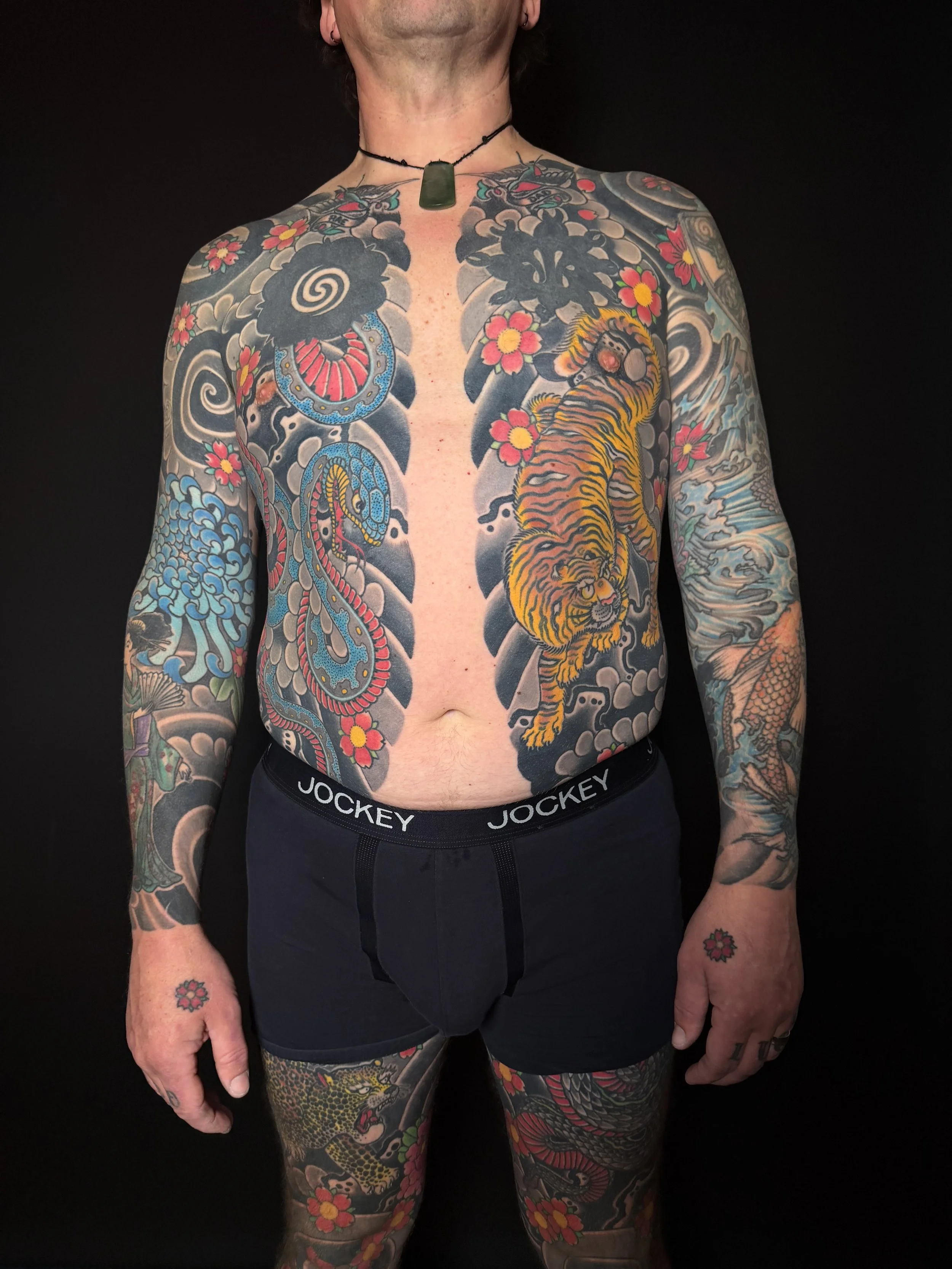
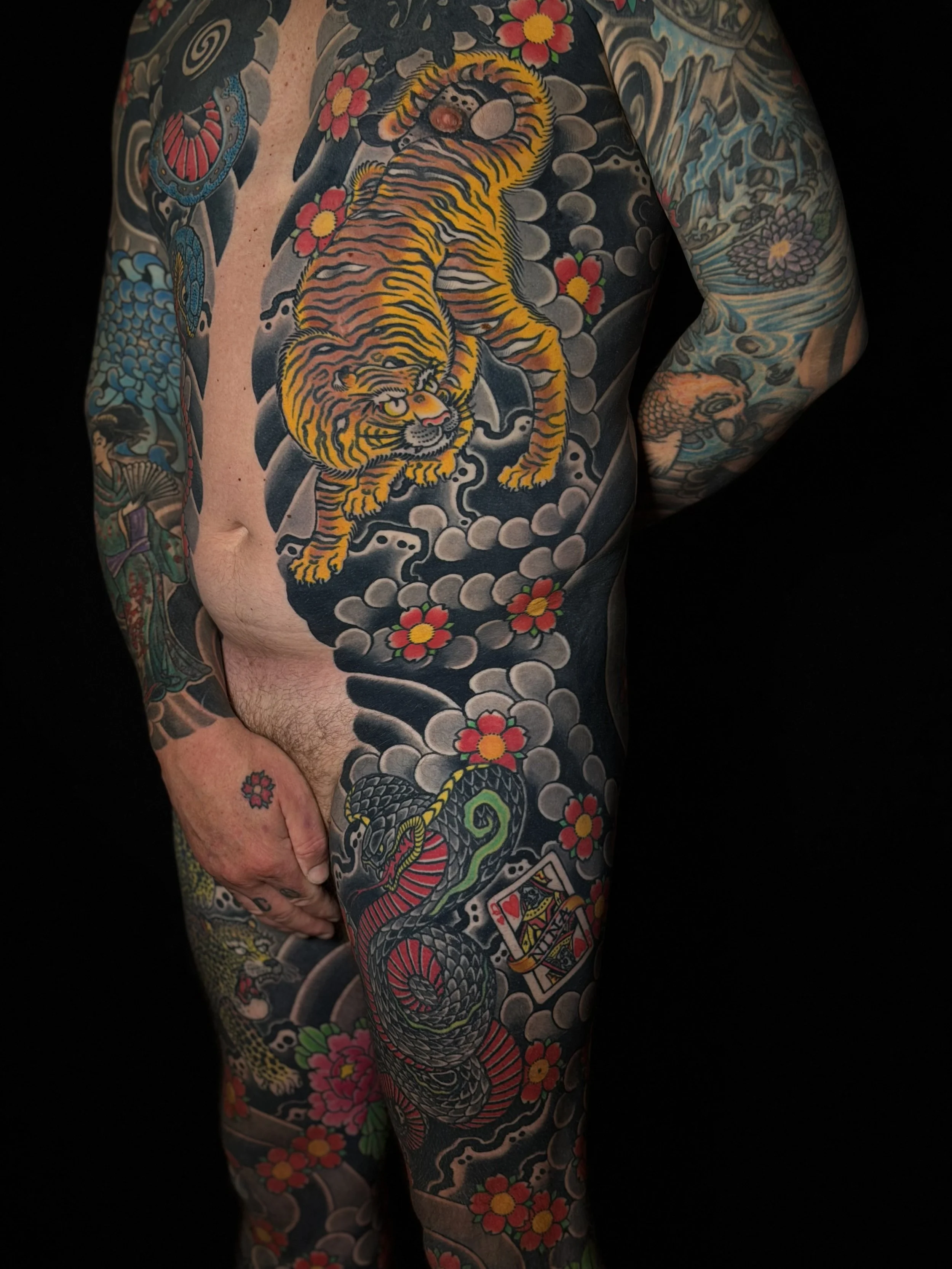
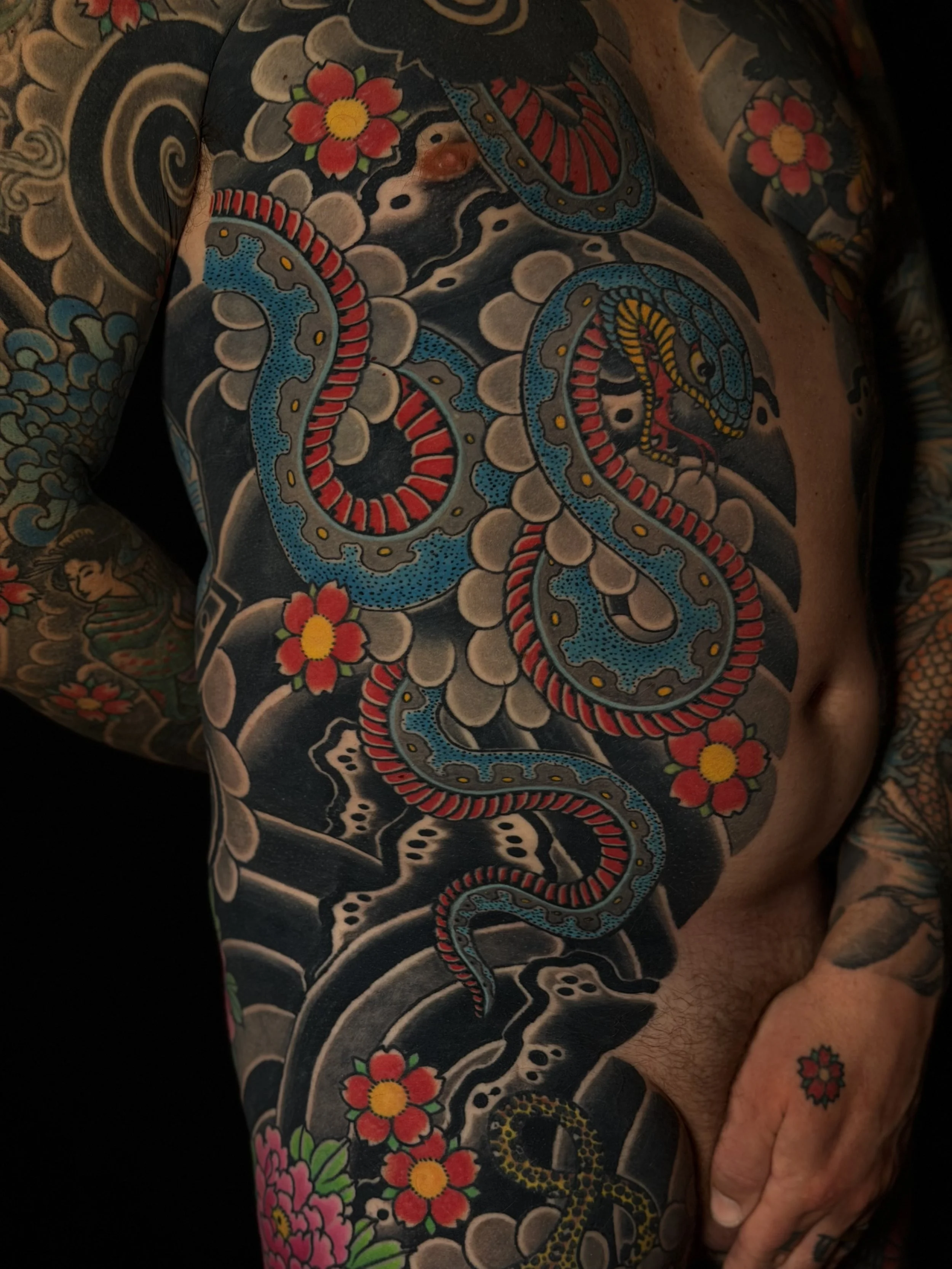
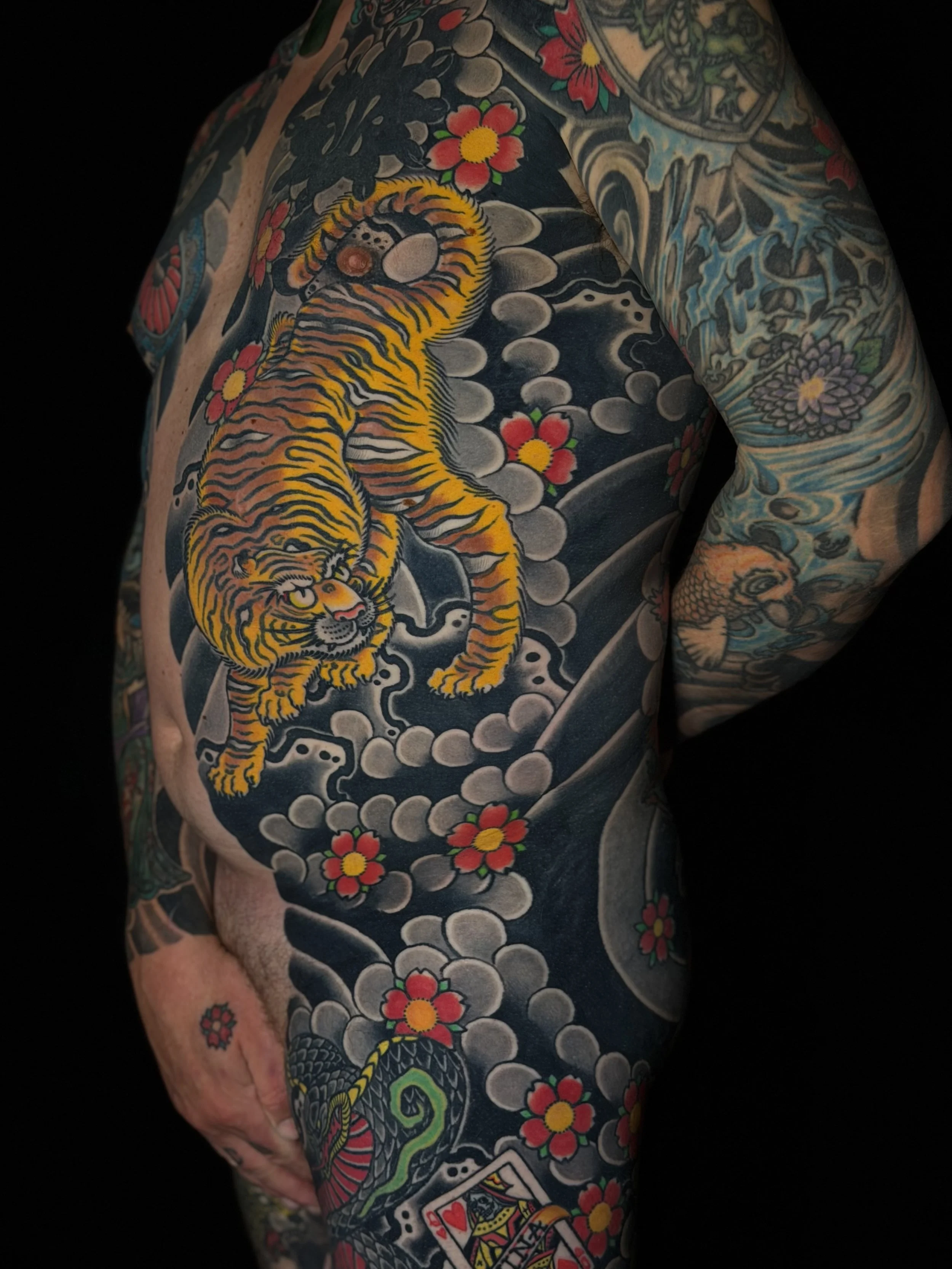
From there we built out across the shoulders, chest and arms. A tiger and a snake facing off down the front, waves and clouds carrying the background through the ribs and stomach, chrysanthemums and koi filling in the sleeves. One sleeve is mostly older work that predates our time together, and rather than replace it I built the surrounding pieces to sit alongside it, so it reads as part of the whole rather than something bolted on.
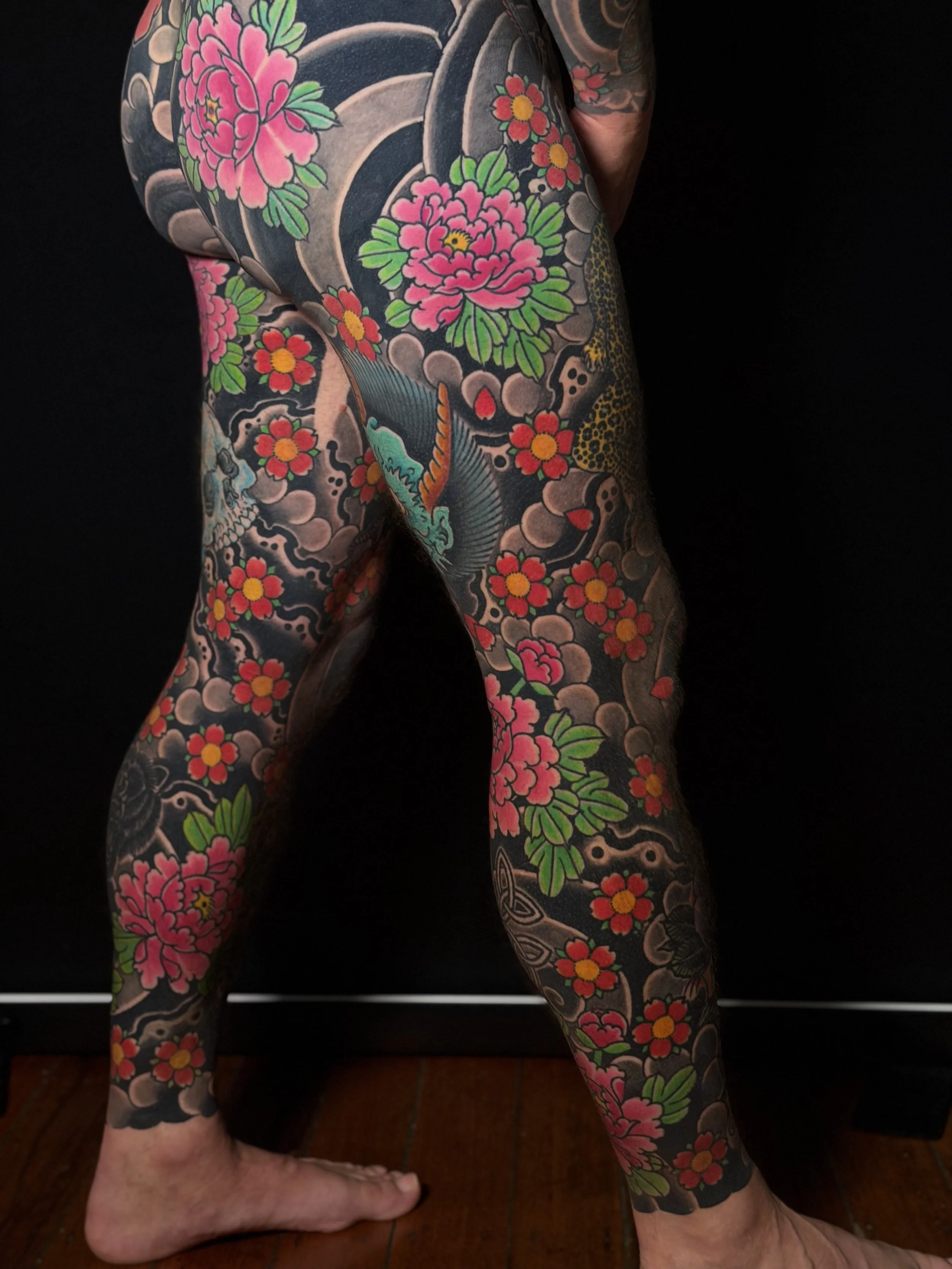
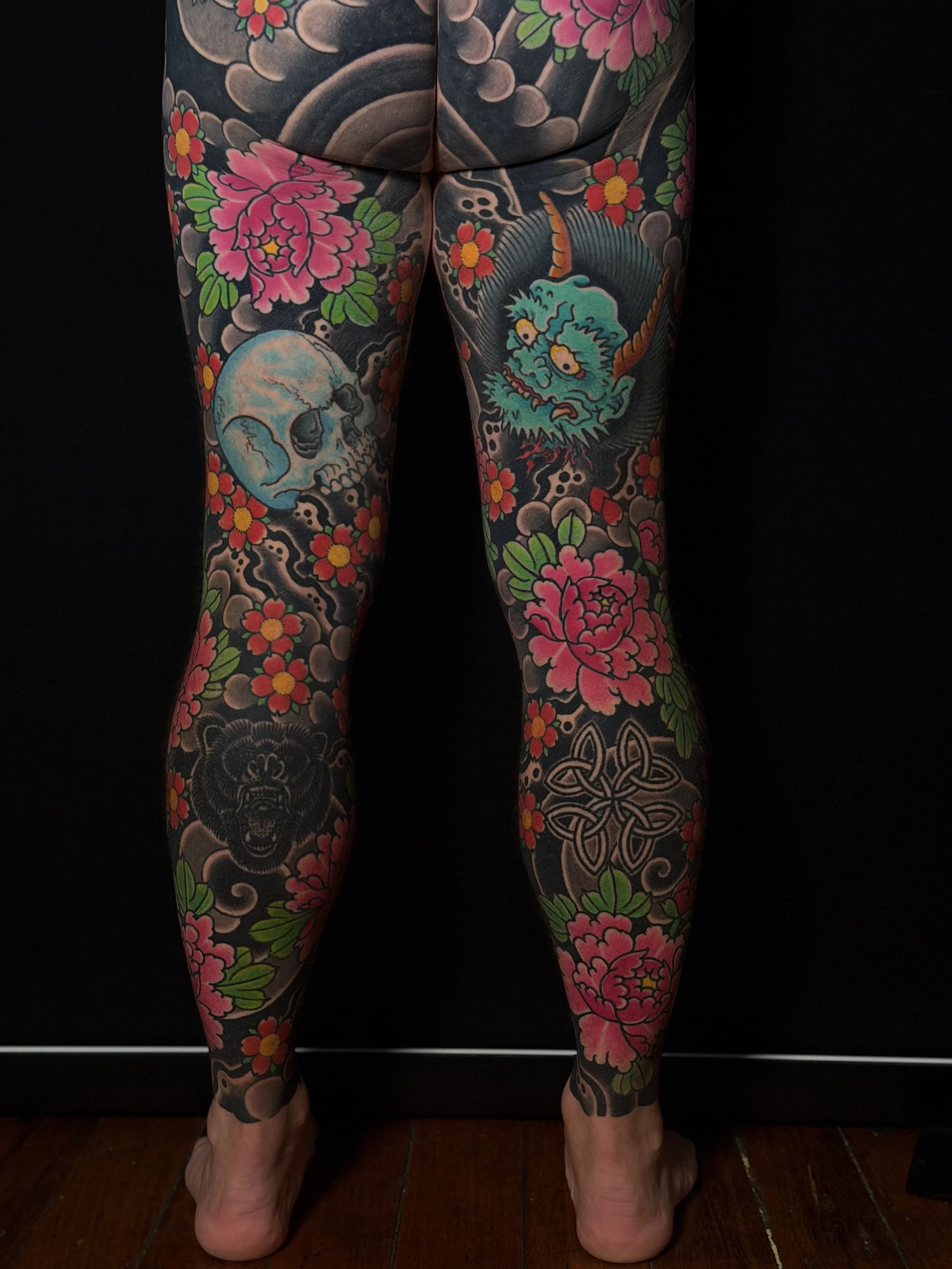
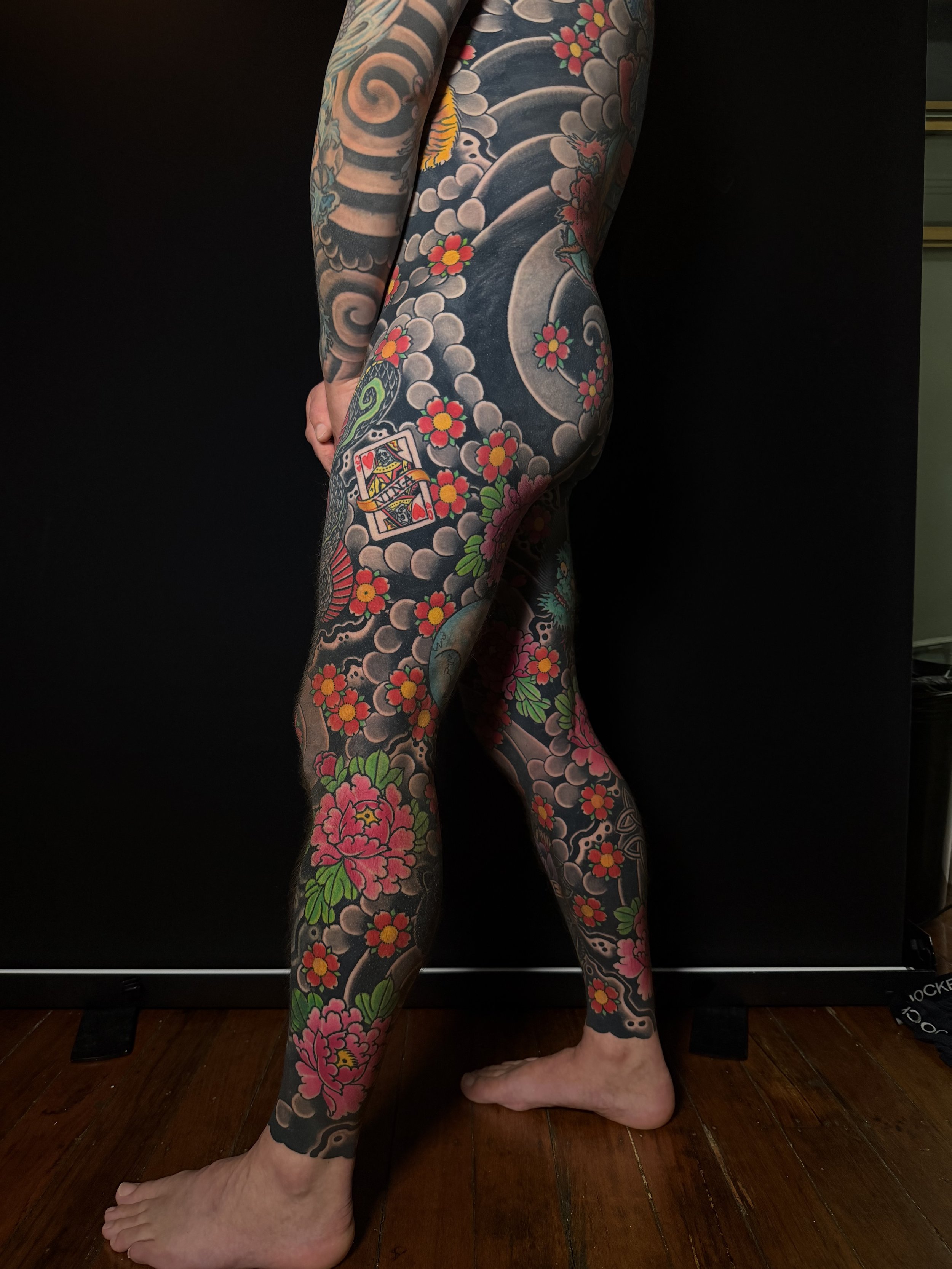
The legs carry the same story straight down without a break; the subject matter shifts a little, but it flows seamlessly out of everything above it rather than starting something new. The two calf pieces are the work of Manawa Tapu, Jason was generous enough to offer his skin to practice on while Manawa was apprenticing under me. They're a nice reminder that this suit isn't just my work, it's part of the wider story of the studio too.
This is what I love about full body work. It's not one tattoo, it's dozens of decisions made in service of a single vision, stretched out over years of sessions, trust, and patience on both sides. Jason committed to seeing this through, and it shows in the final result, a suit that flows, breathes and tells a story from the neck down.
If you've been thinking about starting a full bodysuit, or you've got existing tattoos you'd love to see woven into something bigger, you can book a consultation with me to have a chat about it. This kind of long-term project is exactly the work I want to be doing more of.
A Few Fun One-Shots
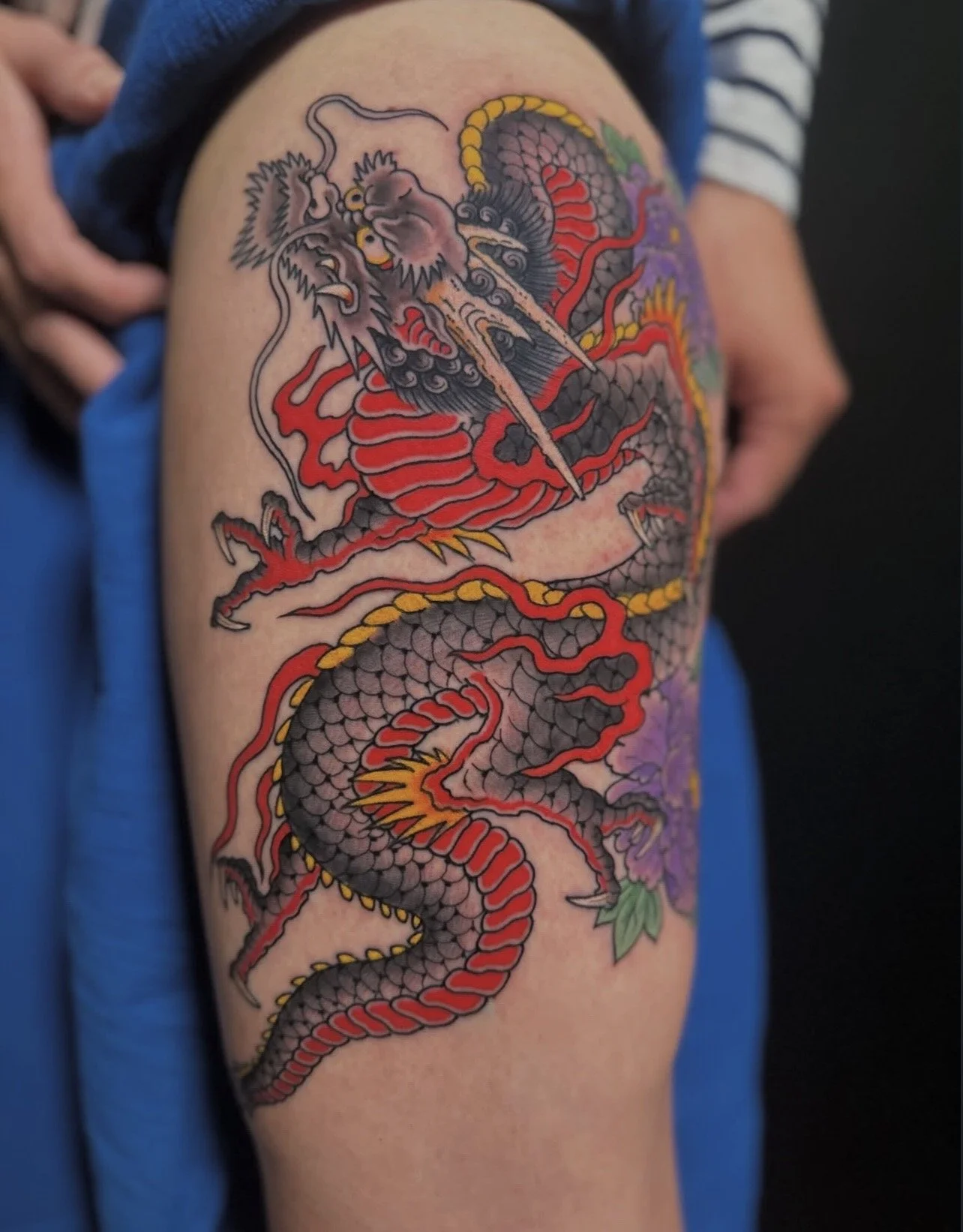
Most of what I do is big. Full sleeves, back pieces, multi-session work that gets planned out over months and built up layer by layer. That's where my head lives most of the time, thinking about flow, composition, how a dragon needs to wrap around an arm or how a peony needs to sit against a wave.
But every now and then someone comes in wanting something smaller. A one-shot. One sitting, one design, done.
There's a different kind of satisfaction in a one-shot piece. No months of planning, no second-guessing composition across multiple sessions, just a solid, well-built image that has to earn its keep in a single sitting. It forces a different kind of discipline.
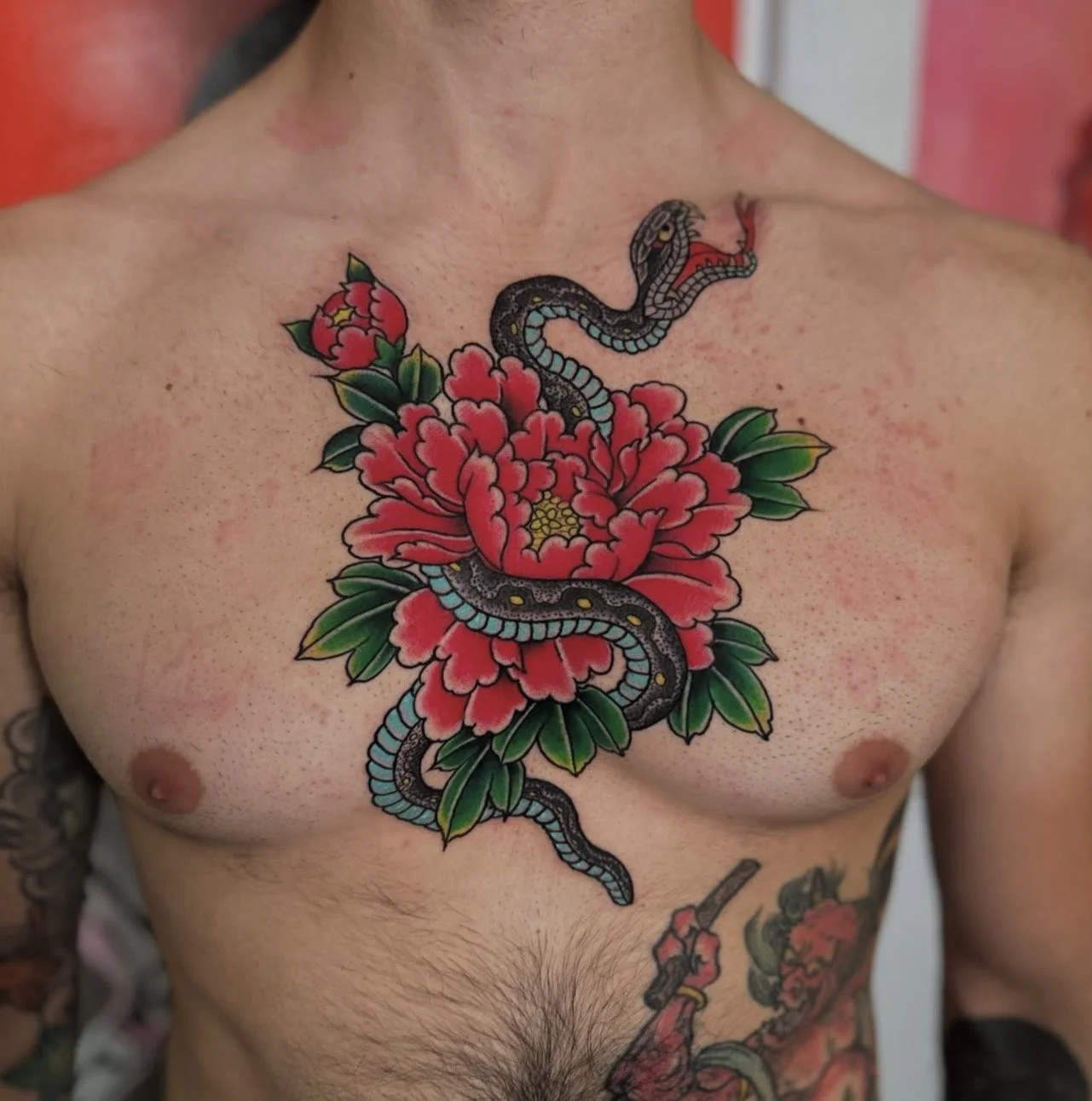
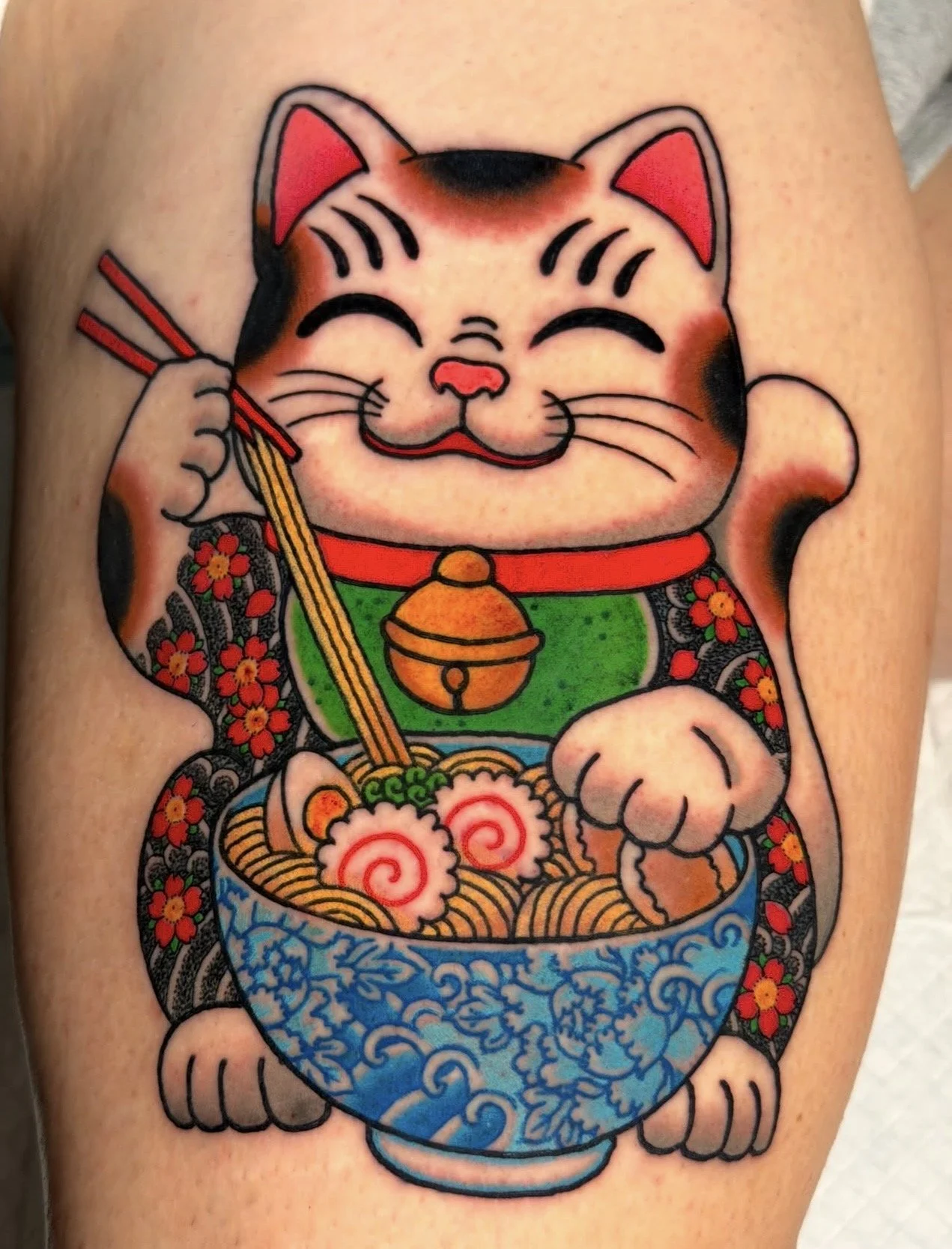
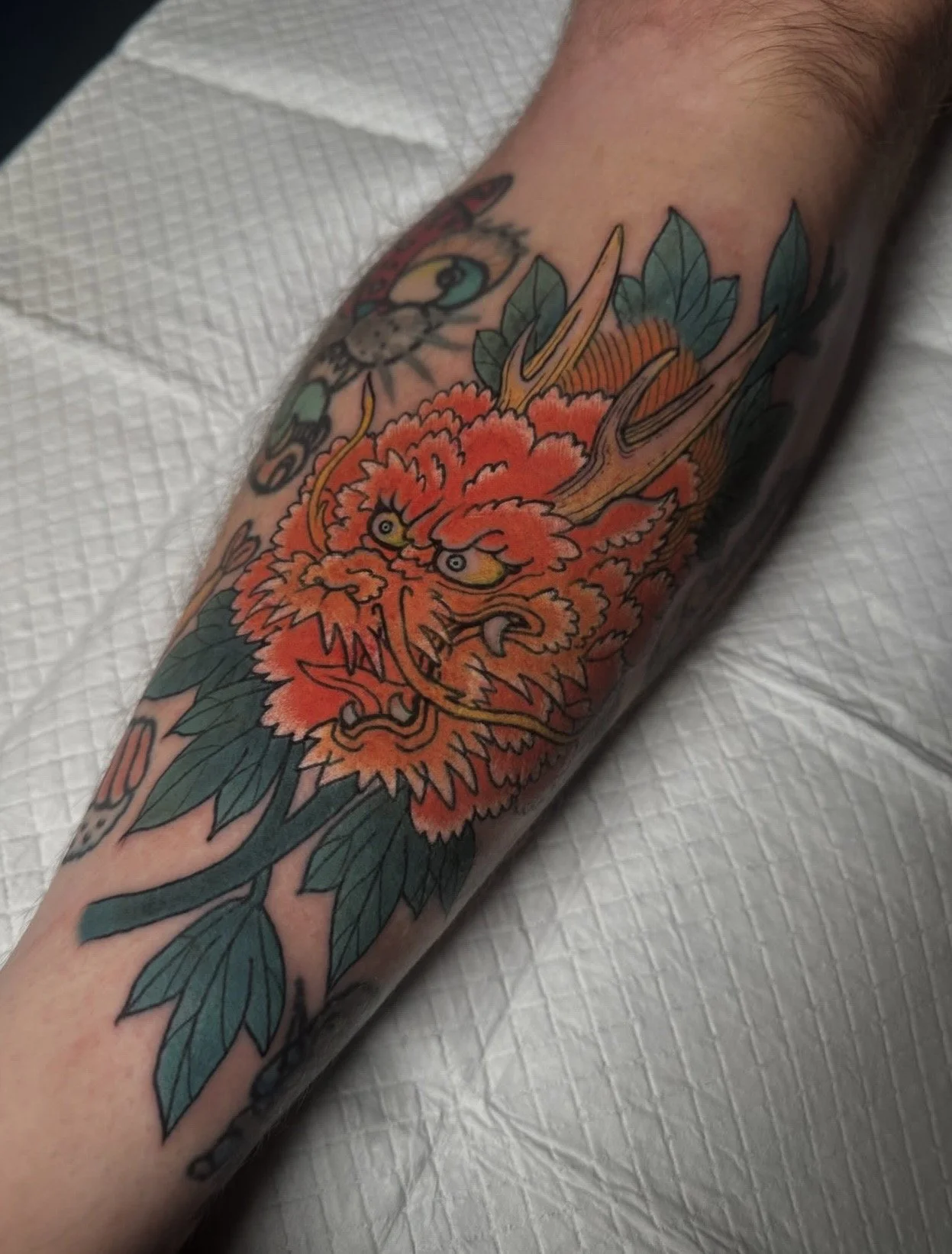
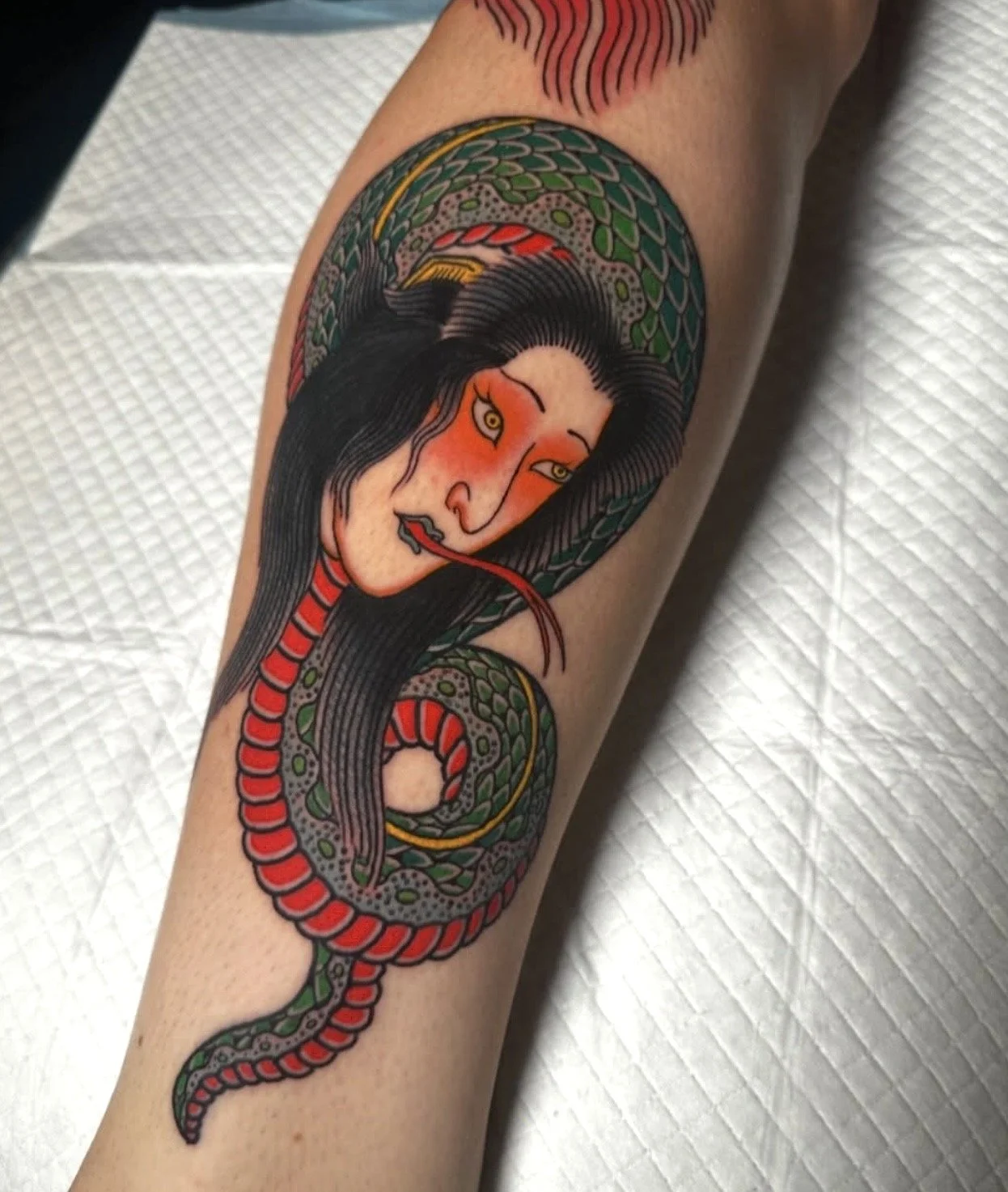
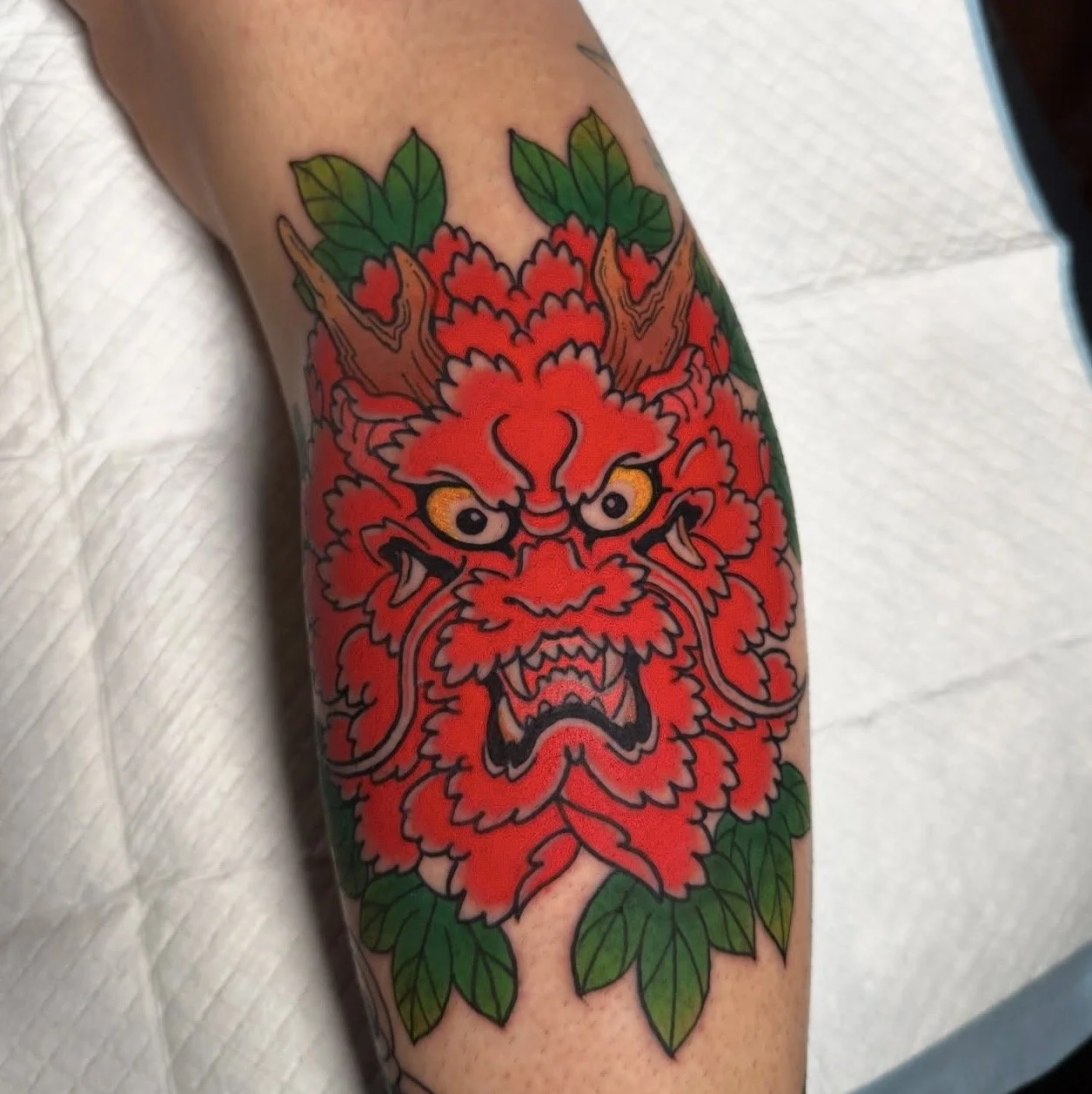
Whether it's a dragon, a nure-onna, a hannya, a snake or a lucky cat, there's so many cool one-shot Japanese tattoos out there. Each of these motifs carries centuries of meaning and imagery, but they don't need a sleeve's worth of real estate to say what they need to say, a dragon can coil into a thigh piece just as well as it can wrap a whole arm, a hannya mask can hold its ground on its own, and even something as playful as a maneki-neko slurping ramen earns its spot without needing any extra symbolism tacked on.
The bigger pieces will always be where I spend most of my time and most of my thinking. But one-shots like these are a good reminder that a single sitting, done right, can hold just as much weight as a sleeve, it just does it faster.
If you've got a one-shot idea rattling around, bring it in. I'm always up for one!
The Simplicity of a Koi Sleeve
There's a temptation, when people think about traditional Japanese tattooing, to assume that bigger means more complicated. More motifs, more meaning, more to explain. But some of the strongest sleeves we do here are the ones that hold back, that trust a single subject to carry the whole arm.
This koi sleeve is one of those pieces.
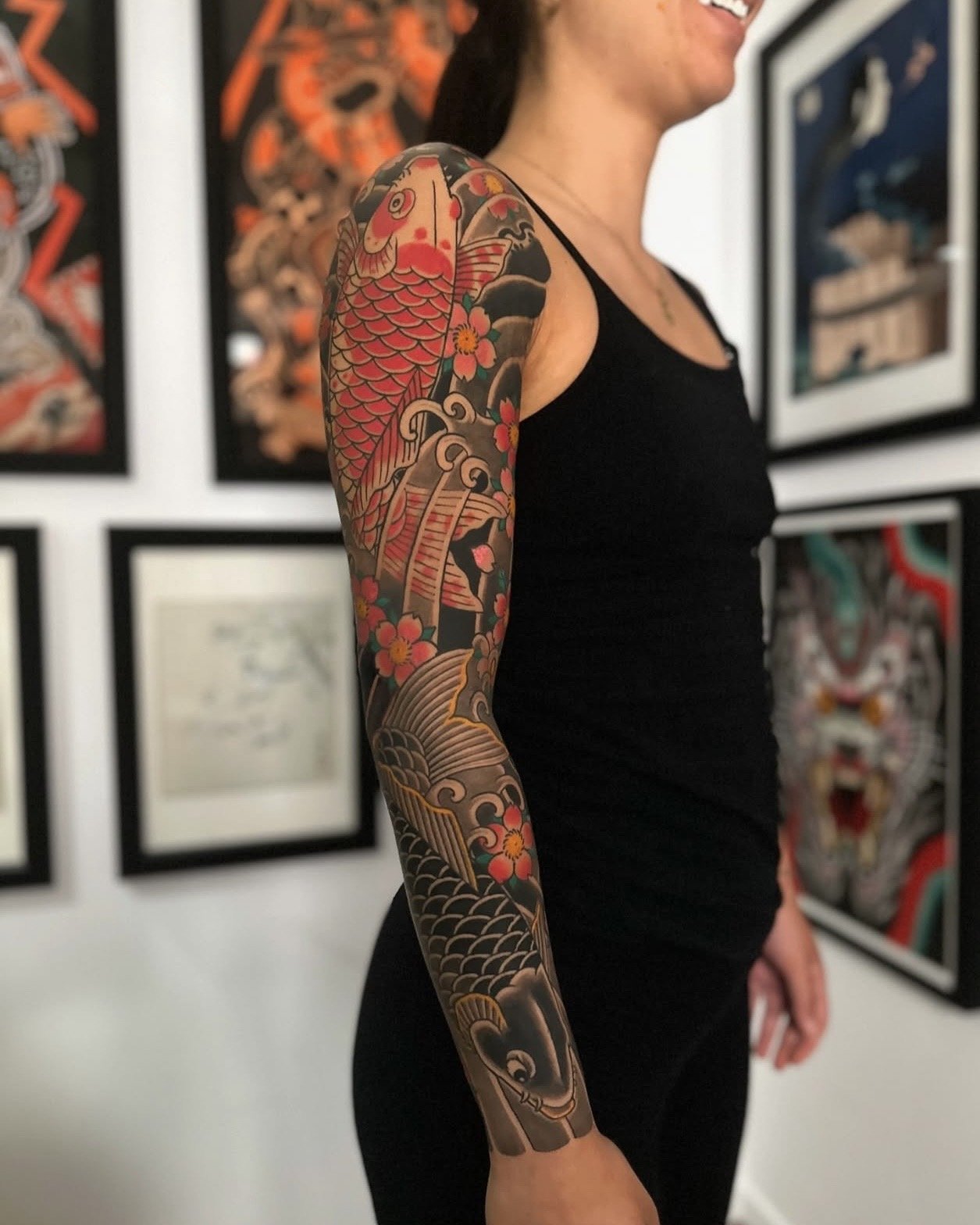
It's a classic pairing in irezumi: the koi shown twice, in two different lights, moving through the same current. There's no dragon here, no elaborate background full of competing elements. Just water, blossom, and fish — repeated, varied, and let to breathe.
That restraint is the point. A koi carries centuries of meaning on its own; strength, perseverance, the willingness to swim against the current rather than drift with it. It doesn't need extra symbols stacked around it to do that work. Cherry blossom softens the piece and marks the passage of time; the waves give the fish somewhere to actually swim, rather than floating on flat skin.
A simple concept doesn't mean a simple sleeve. With fewer motifs, every decision carries more weight, the size and placement of each scale, the exact gradient from red to black, the negative space that lets the eye rest between one koi and the next. There's nowhere for a mistake to hide behind a busier composition.
This is where classical training shows. Getting a koi to look alive caught mid-motion, water pulling at its fins, takes the same discipline whether it's one fish or ten. The sleeve holds together because the line work, the shading, and the flow up the arm were all planned as one continuous piece from the very start, not stitched together panel by panel.
There's also a practical argument for simplicity: this kind of tattoo holds up. Bold koi, deep blacks, and clean scale work are built to still read clearly in twenty years. It's a design choice as much as an aesthetic one.
If you're drawn to irezumi but feel like a full sleeve needs to tell ten stories at once, this piece is proof it doesn't. Sometimes one fish, swimming twice, is enough.
Skeletal Samurai
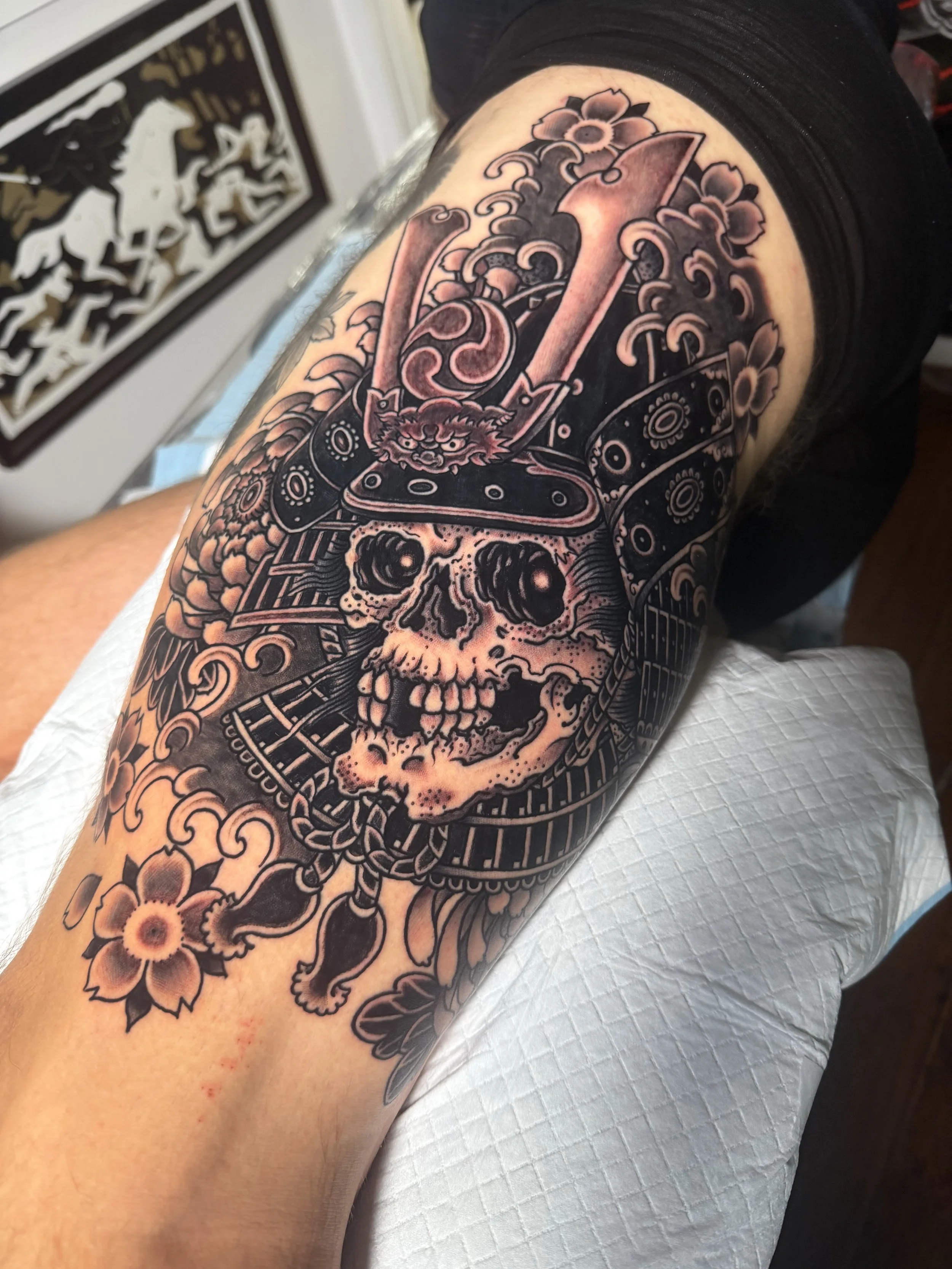
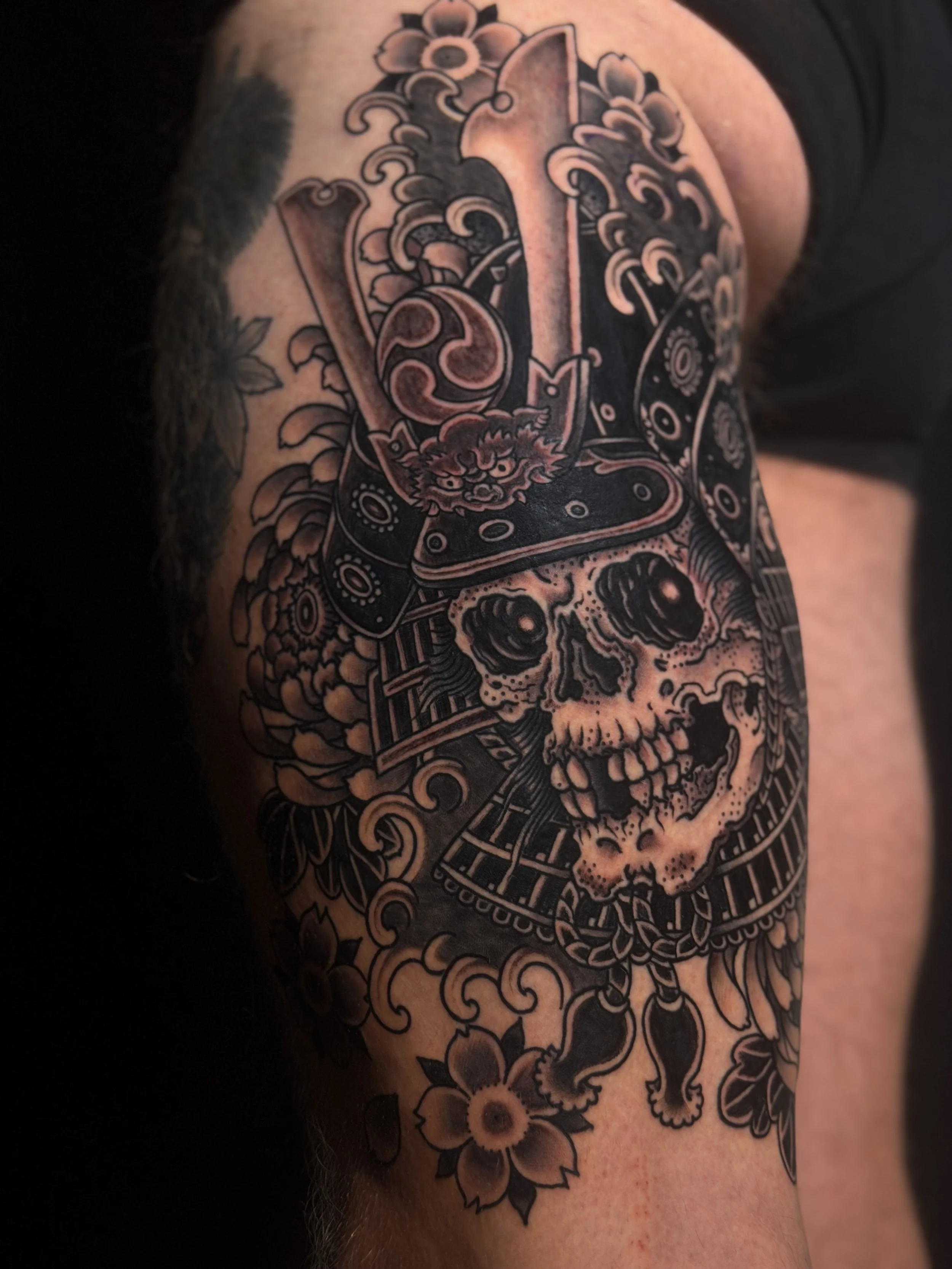
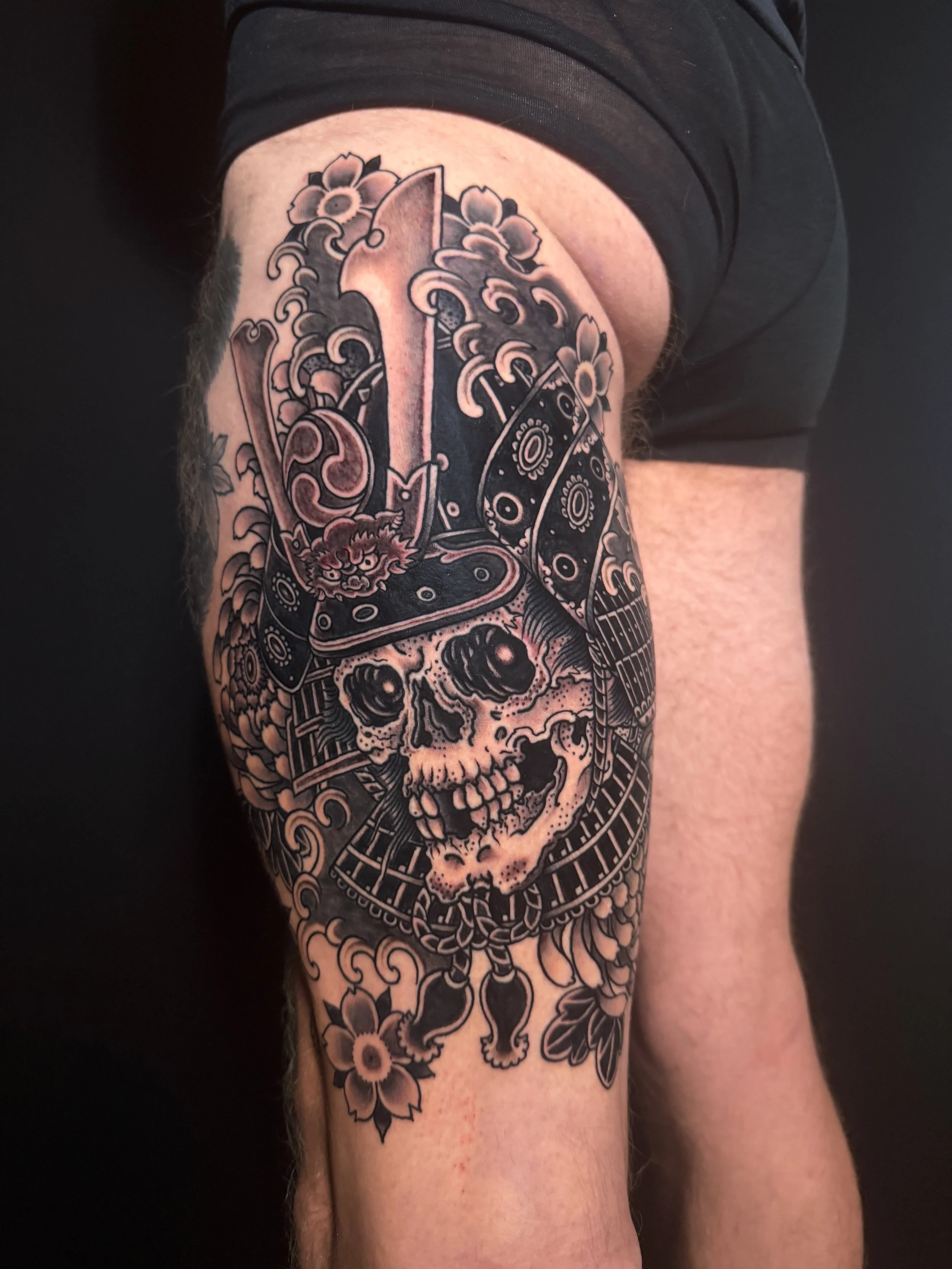
This bold Japanese thigh piece features a skeletal samurai surrounded by traditional Japanese elements, all brought together in a black and grey style. The tattoo was completed over two days, making it a great example of what can be achieved when you’re working with a limited amount of time.
The client was travelling and only had two days available for their tattoo, so the design and sessions were planned around that timeframe. The result is a detailed piece featuring the skeleton samurai as the main focus, with flowing Japanese waves and sakura blossoms wrapping around the outside to give the tattoo movement and balance.
The skeleton samurai brings a darker, more dramatic feel to the traditional Japanese imagery, while the sakura adds contrast and a softer element to the overall design. The waves help tie everything together and work naturally with the shape of the thigh.
If you’re travelling through Auckland or have a limited window for getting tattooed, that doesn’t mean you have to compromise on the size or quality of your piece. With the right planning, we can work within your timeframe and create something seriously epic, even if you’ve only got a couple of days.
Healed Arm Sleeves
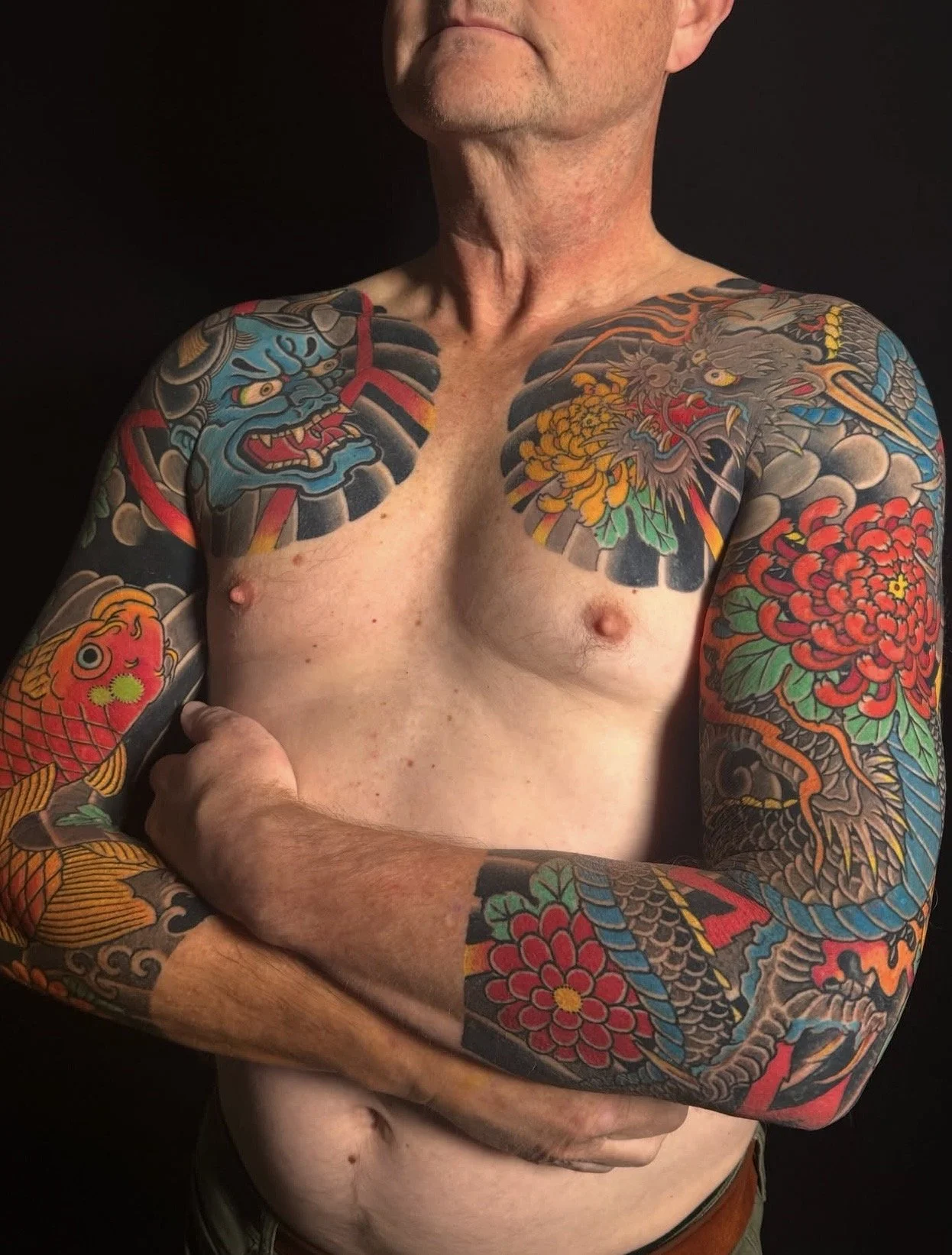
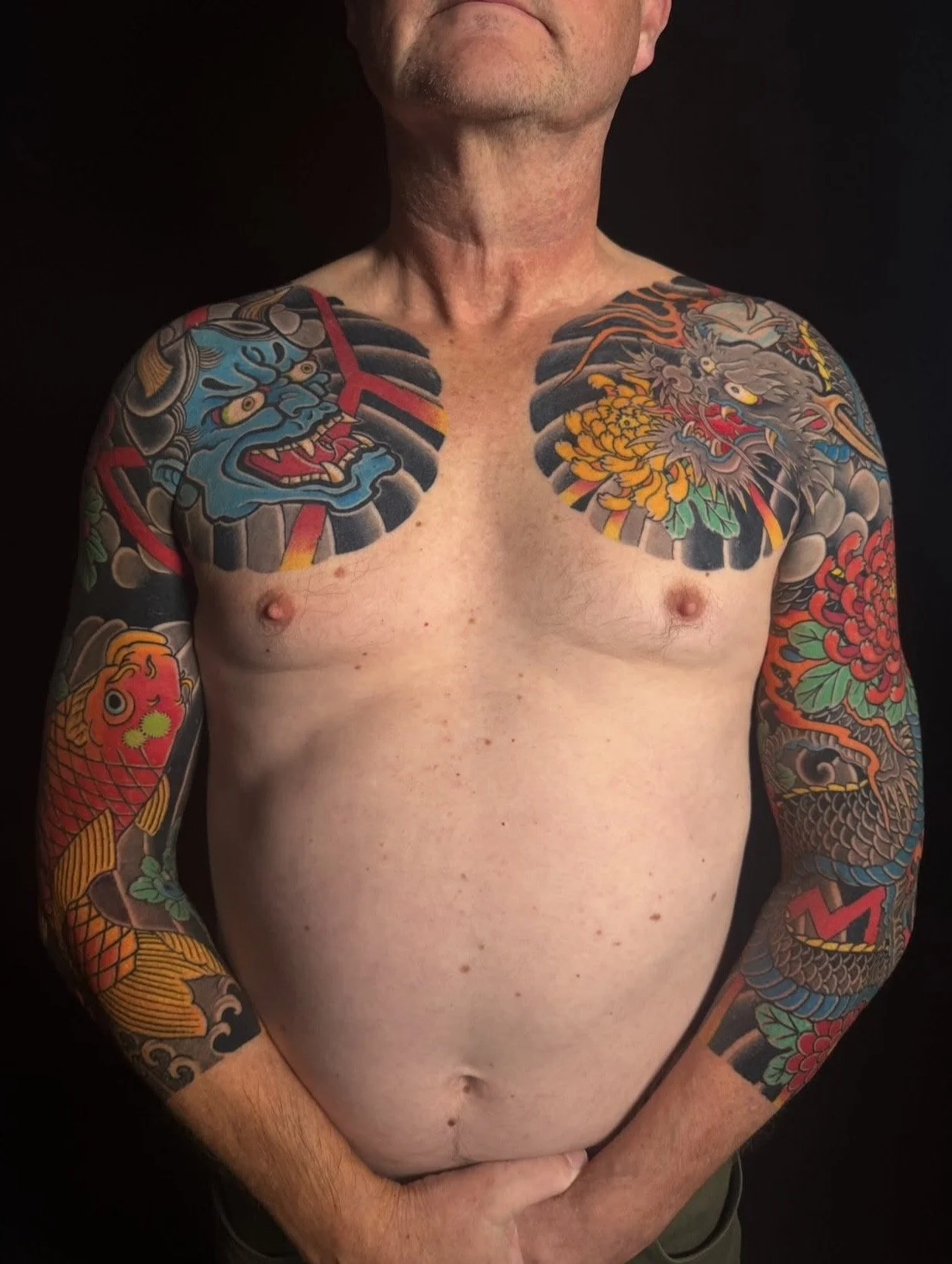
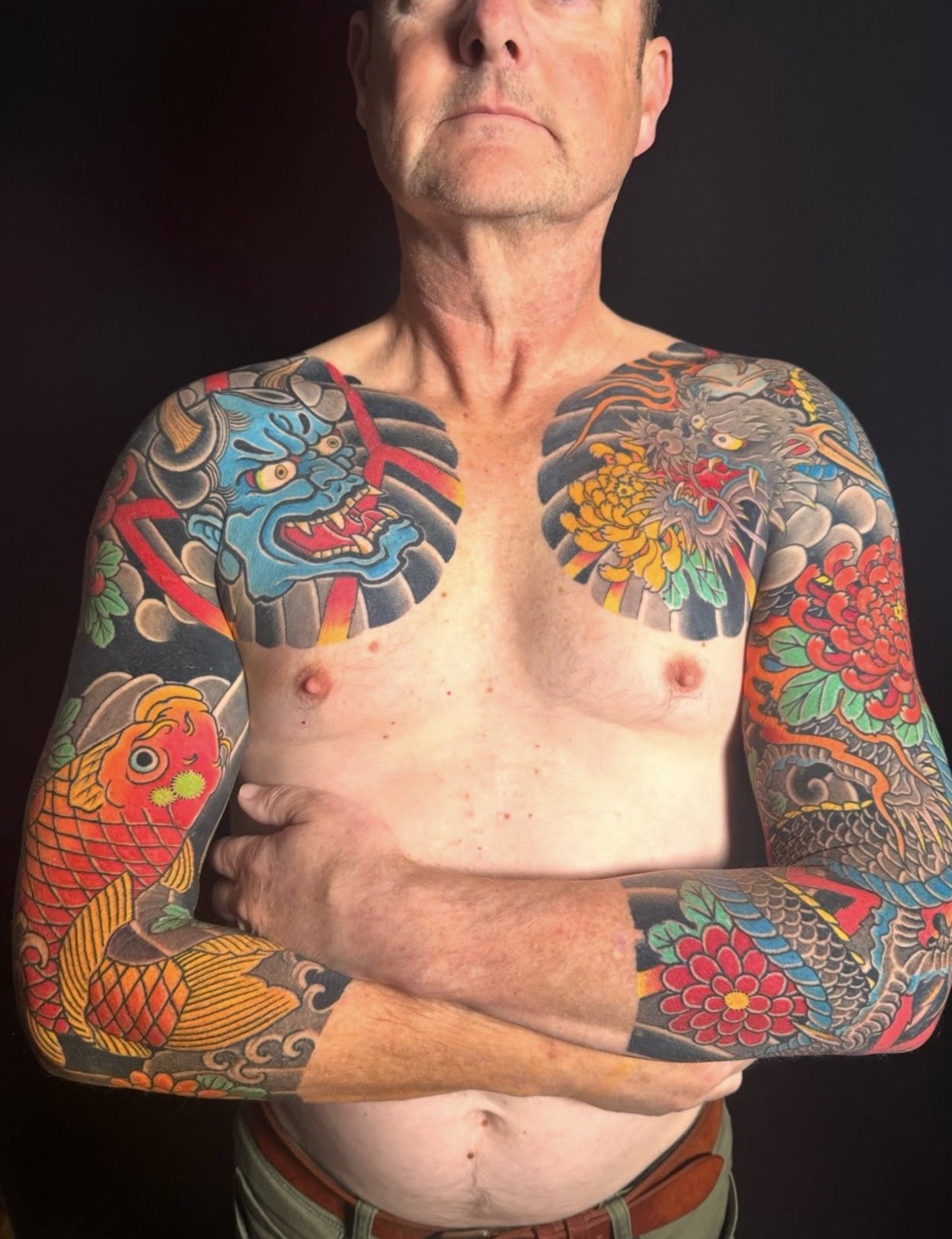
Some of the best moments in this studio don't happen on the tattoo table, they happen months later, when a client walks back in and the work has finally settled into the skin. That's exactly what we're celebrating with this set of photos: two full sleeves, taken from chest to wrist, completely healed and sitting exactly where they should.
The left sleeve pairs a Hannya mask on the chest and shoulder with a koi swimming up the forearm. In Japanese folklore, the Hannya is the mask of a woman transformed by rage and heartbreak into a demon; her horns, gilded fangs, and wide, furious eyes are classic hallmarks of Noh theatre, where the mask represents jealousy, sorrow, and the darker side of love.
Beneath the Hannya, the koi carries an entirely different energy. Koi are symbols of perseverance and strength, tied to the old story of a carp swimming against the current until it becomes a dragon. Paired together on one arm, the Hannya and the koi tell a quiet story of struggle and resilience sitting side by side, one figure already transformed, the other still making her way upstream.
The right sleeve is anchored by a dragon winding from the shoulder down through the bicep, framed by a burst of chrysanthemums in red and gold across the chest and upper arm. Dragons in Japanese tattooing are protective, wise creatures rather than the fire-breathing villains of Western folklore, they're associated with strength, good fortune, and mastery over the elements, particularly water and weather.
The chrysanthemum, or kiku, is one of the most significant flowers in Japanese culture, historically linked to the Imperial family and to ideas of longevity, honour, and rejuvenation. Set against the dragon's scales and clouds, the flowers soften the composition without taking anything away from its power,a reminder that strength and beauty were never meant to be separate ideas in this style of tattooing.
What makes this piece work as a set isn't just the symmetry, it's the way the negative space, the wave and cloud backgrounds, and the colour palette carry across both arms and into the chest panels, so the whole thing reads as one continuous piece of work rather than two separate tattoos. That's the heart of traditional Japanese tattooing: every element supports the next, and the background is never just filler.
Healing is the final test of any large-scale piece. Colours that looked bold on day one need to hold their saturation once the skin settles, lines need to stay crisp, and shading needs to keep its depth. A year or two down the track, this is exactly what that process looks like when it's done right.
If you're considering a full sleeve or a chest-and-arm combination of your own, get in touch, I’m always happy to talk through concept, placement, and how a piece like this is built to age well.
Raijin Arm Sleeve
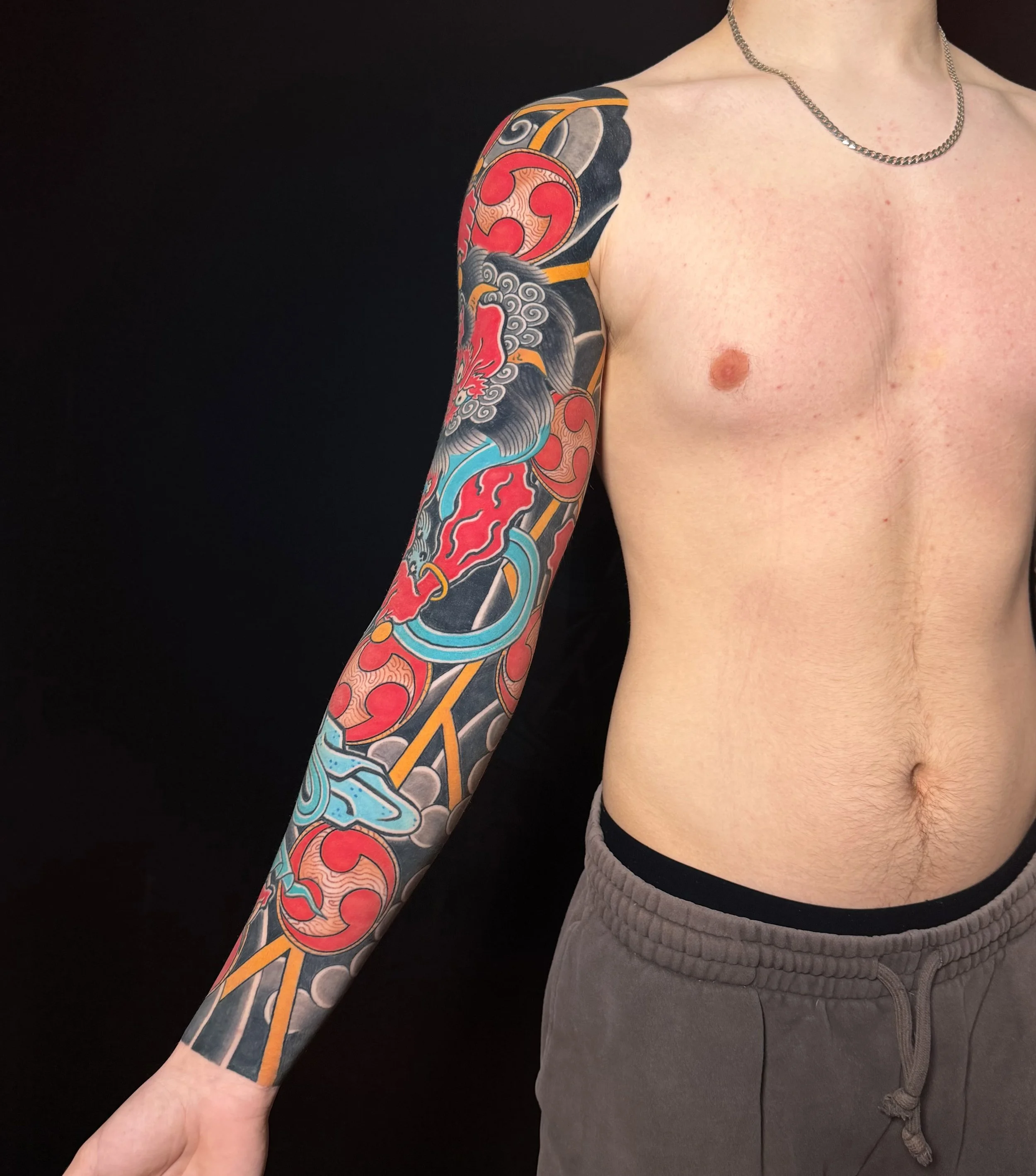
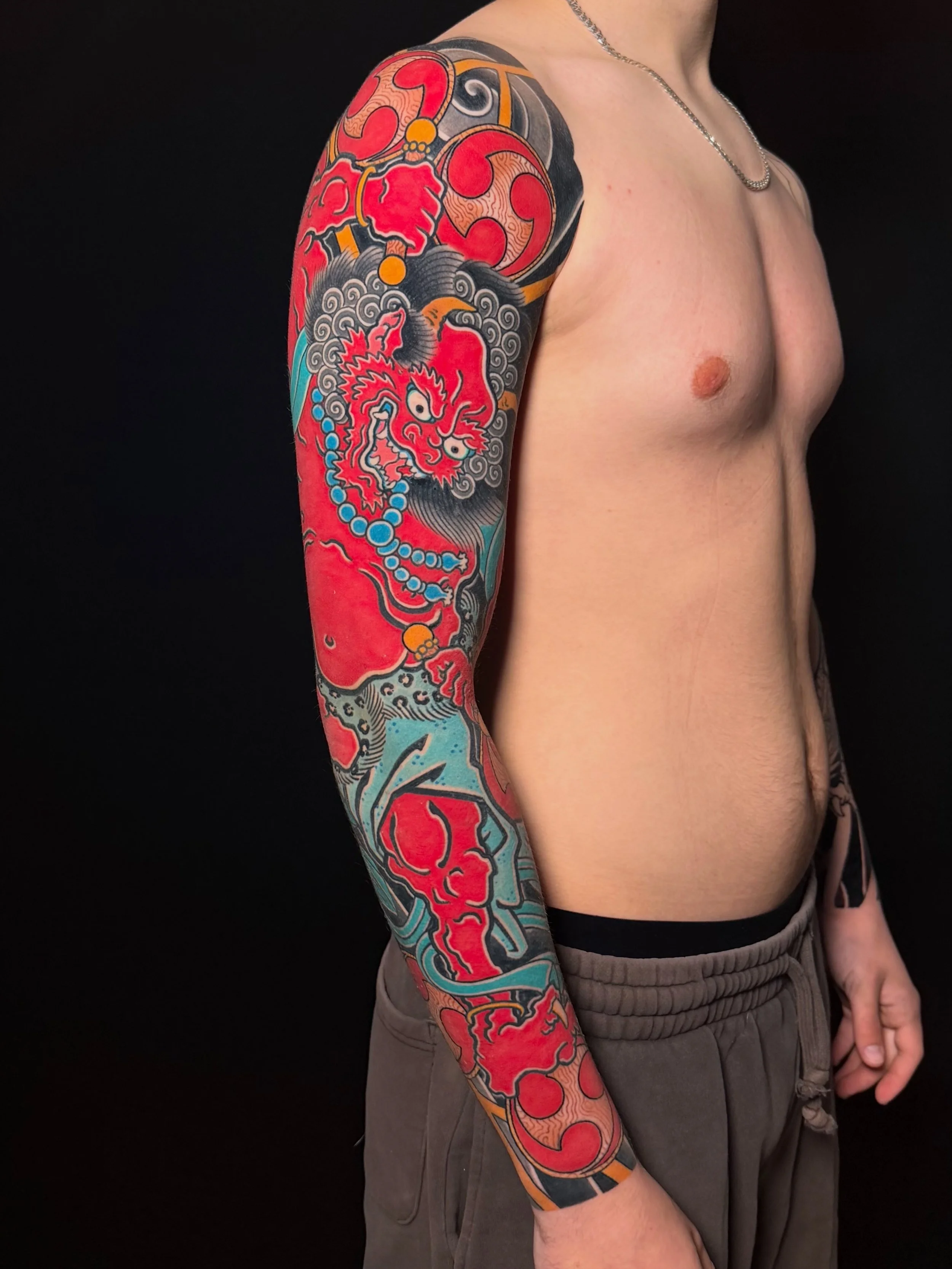
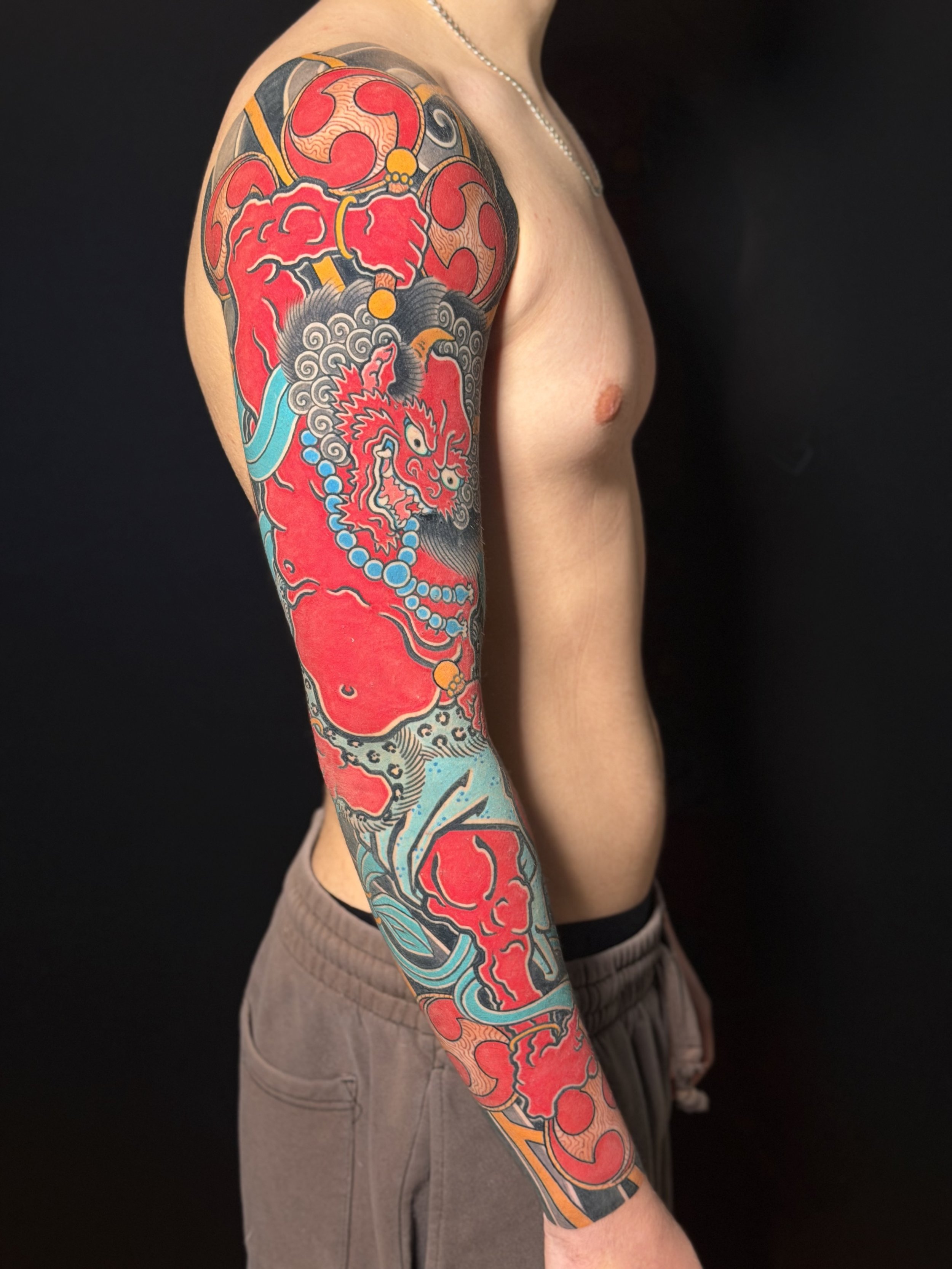
This sleeve is built around Raijin, the god of thunder and lightning in Japanese mythology, one of the most recognisable figures in the traditional canon, and one of the most fun to tattoo.
You can tell it's Raijin by the drums. In the old woodblock prints, he's shown surrounded by a ring of taiko, striking them to make thunder, and that ring is exactly what wraps around this sleeve, the red discs with the swirling tomoe pattern climbing from the shoulder down to the wrist. His skin is red, his hair and beard whipped up into wild spirals, and his face is caught mid-snarl, which is how he's almost always drawn. He's not a gentle god.
The palette does a lot of the storytelling here. Red carries the whole piece, which is unusual; most traditional sleeves lean on black and grey with colour used sparingly, but Raijin is one of the figures where going heavy on red is correct rather than excessive. It's broken up with cool blue-grey clouds and a string of prayer beads in a soft turquoise, which stops the red from overwhelming the arm and gives the eye somewhere to land.
If you're after a sleeve with this kind of scale and mythology behind it, get in touch and I’ll talk through what it takes to get there.
Big Tiger for Bernie
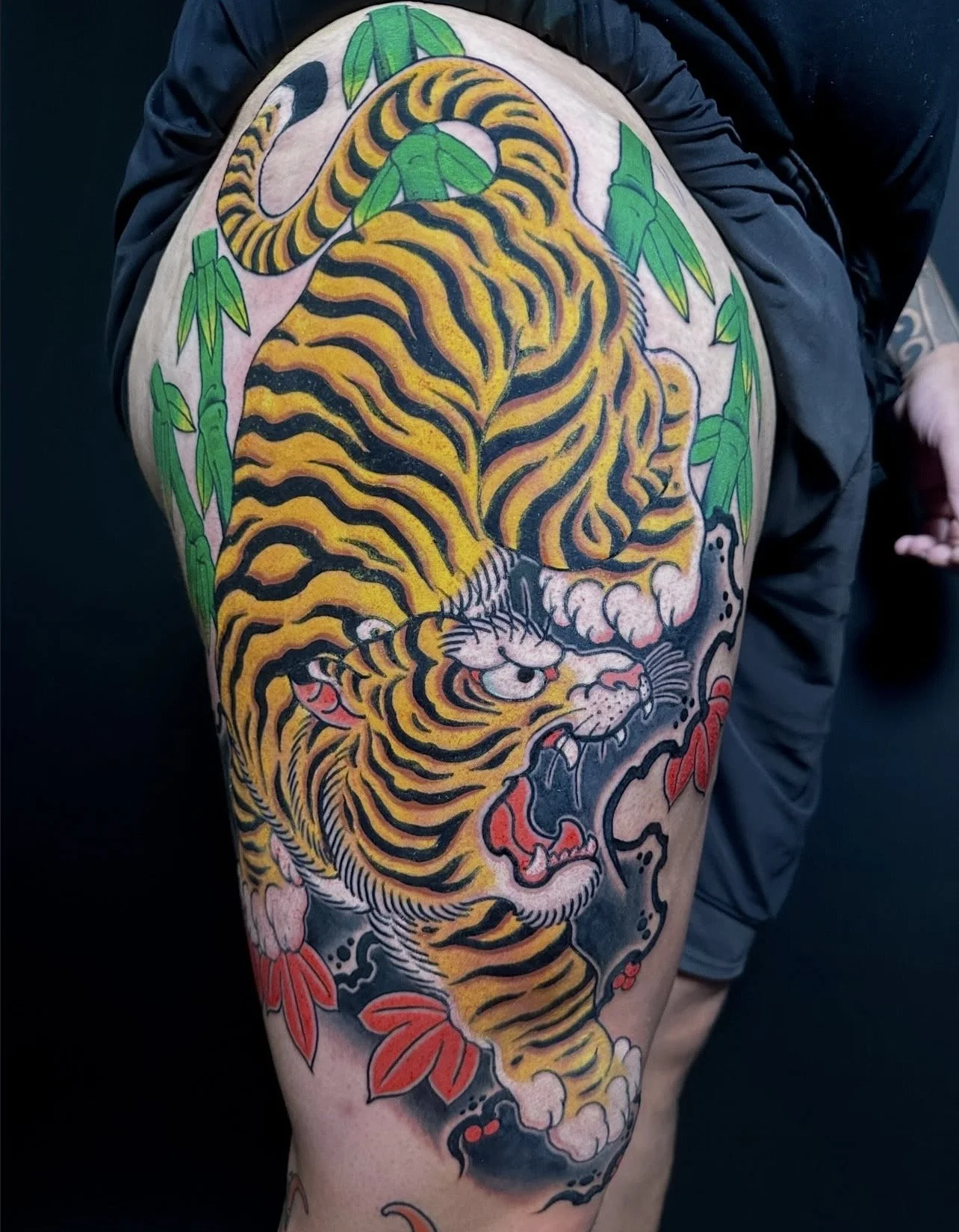
This one's for Bernie; a bold Japanese tiger taking up the whole thigh, snarling mid-turn with bamboo and maple leaves filling the space around it.
You don't need to commit to a full leg to go big. A piece like this shows what's possible working within a single panel, the thigh gives enough room for scale, detail, and a proper background without needing to plan out hip to ankle from day one. And if Bernie ever wants to extend down the leg later, the composition's been left open for it, the placement and flow were planned with that in mind, so it can grow into a bigger piece down the line without needing to be reworked.
Done over two back-to-back day sessions, the piece holds the density and boldness classic Japanese tattooing is known for; heavy black, saturated colour, and a composition that fills the space without crowding it.
If you're thinking about a large-scale piece but aren't ready to commit to a full sleeve or leg, get in touch; we can plan something that stands on its own now and leaves the door open for later.
Tiger and Sakura Arm Sleeve
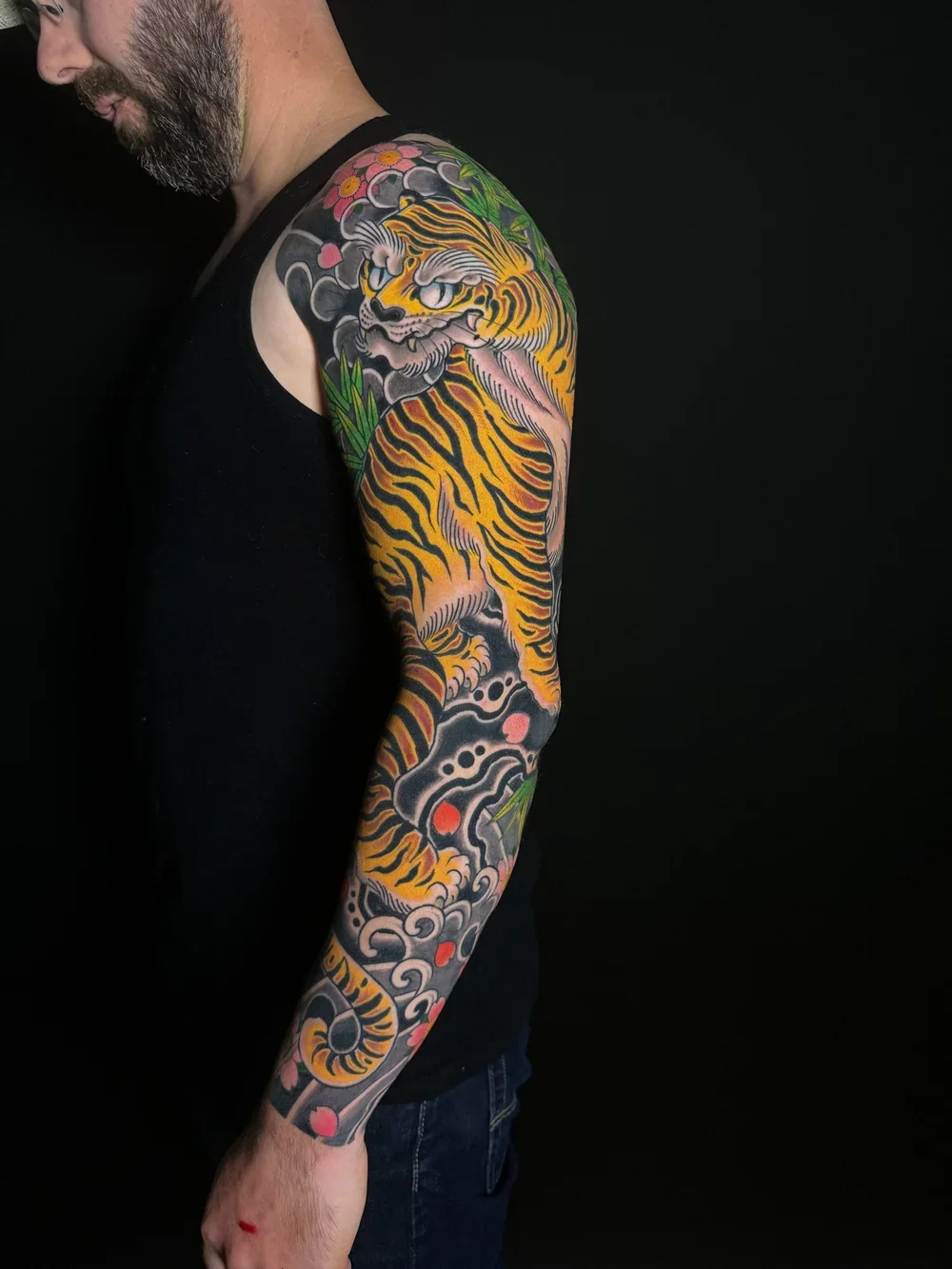
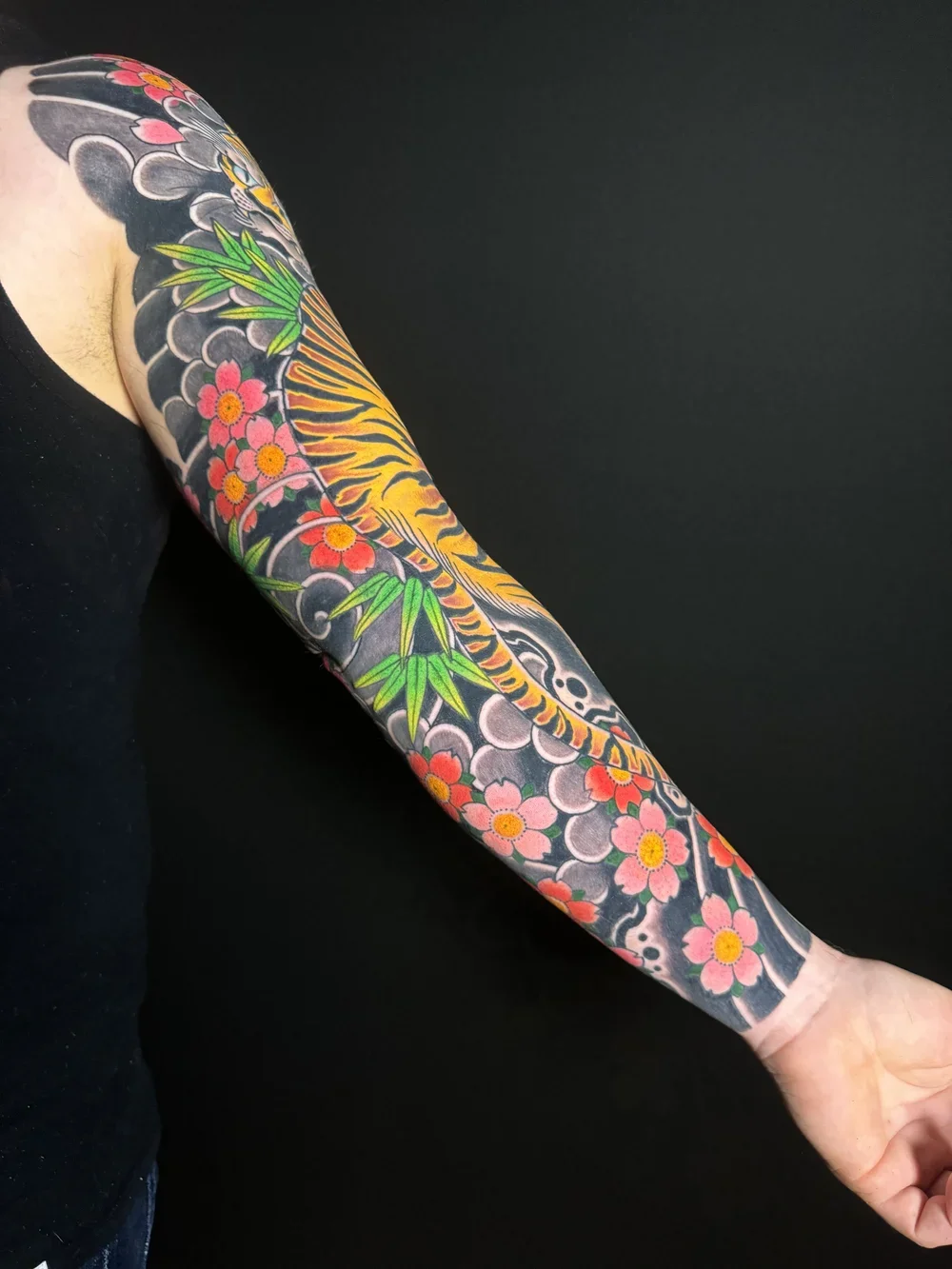
In Japanese tattooing, the tiger is traditionally a protector; warding off misfortune, disease, and evil spirits. It's a classic Irezumi subject, and one of the hardest to get right.
This sleeve builds the tiger through the elements the style is known for: cherry blossoms drifting across clouded negative space, bamboo for strength and flexibility, with wind bars and waves carrying the piece down to the wrist. The stripes follow the natural curve of the arm, so the whole thing reads as one continuous image rather than separate parts stitched together.
Full sleeves like this take time, built up gradually over sessions. The result is bold, legible, and true to the tradition it draws from.
If you're considering a Japanese-style sleeve, get in touch, I’m happy to talk through concepts and placement.
Tui and Manuka Blossom Sleeve
This Tui and Manuka blossom arm sleeve is a great example of blending native New Zealand imagery with traditional Japanese tattoo elements.
The Tui, native to New Zealand, is recognised for its distinctive appearance and song. In tattoo art, the Tui symbolises attributes such as grace, adaptability, and resilience. Its iridescent feathers and striking form can add a sense of dynamism and elegance to a tattoo design, reflecting a connection to nature and a celebration of its inherent beauty.
Manuka blossoms are known for their delicate appearance and vibrant colours. They are often associated with themes of purity, renewal, and healing due to their medicinal properties and visual appeal. In Japanese tattoos, Manuka blossoms introduce a layer of symbolic meaning that complements the natural elements of the design, representing personal growth and the restorative qualities of nature.
When combined in a tattoo, the Tui bird and Manuka blossoms create a design that is both visually striking and rich in meaning. The Tui's detailed feathers and the soft, intricate petals of the Manuka blossoms are thoughtfully integrated to achieve a balanced and cohesive design that is not only aesthetically pleasing but also carries a depth of personal and symbolic significance.
The placement of the three Tui in this sleeve was carefully planned to allow each bird its own position while showcasing the wings. The central Tui, placed on the bicep, is shown with its wings fully spread, creating an impactful and visually expansive effect.
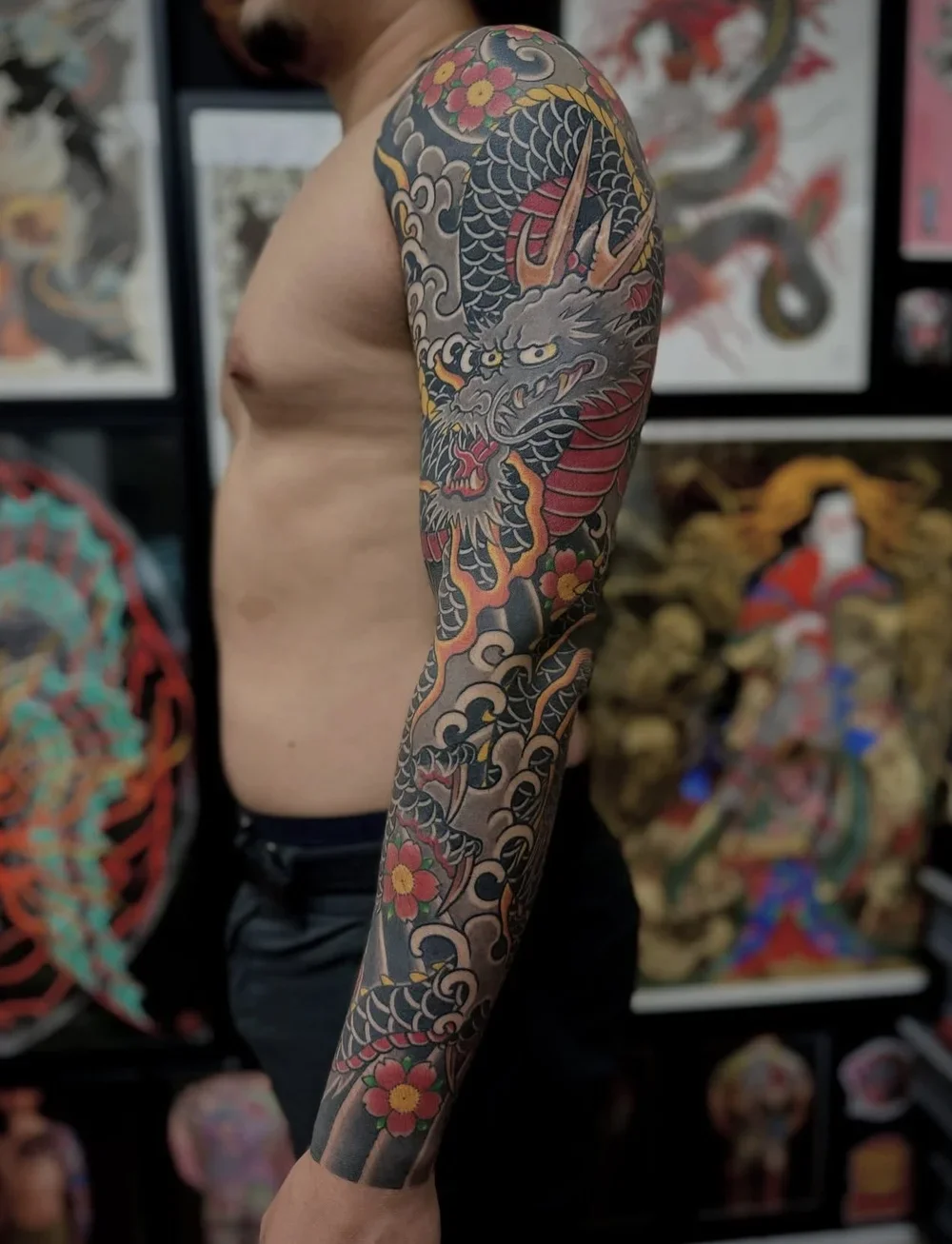
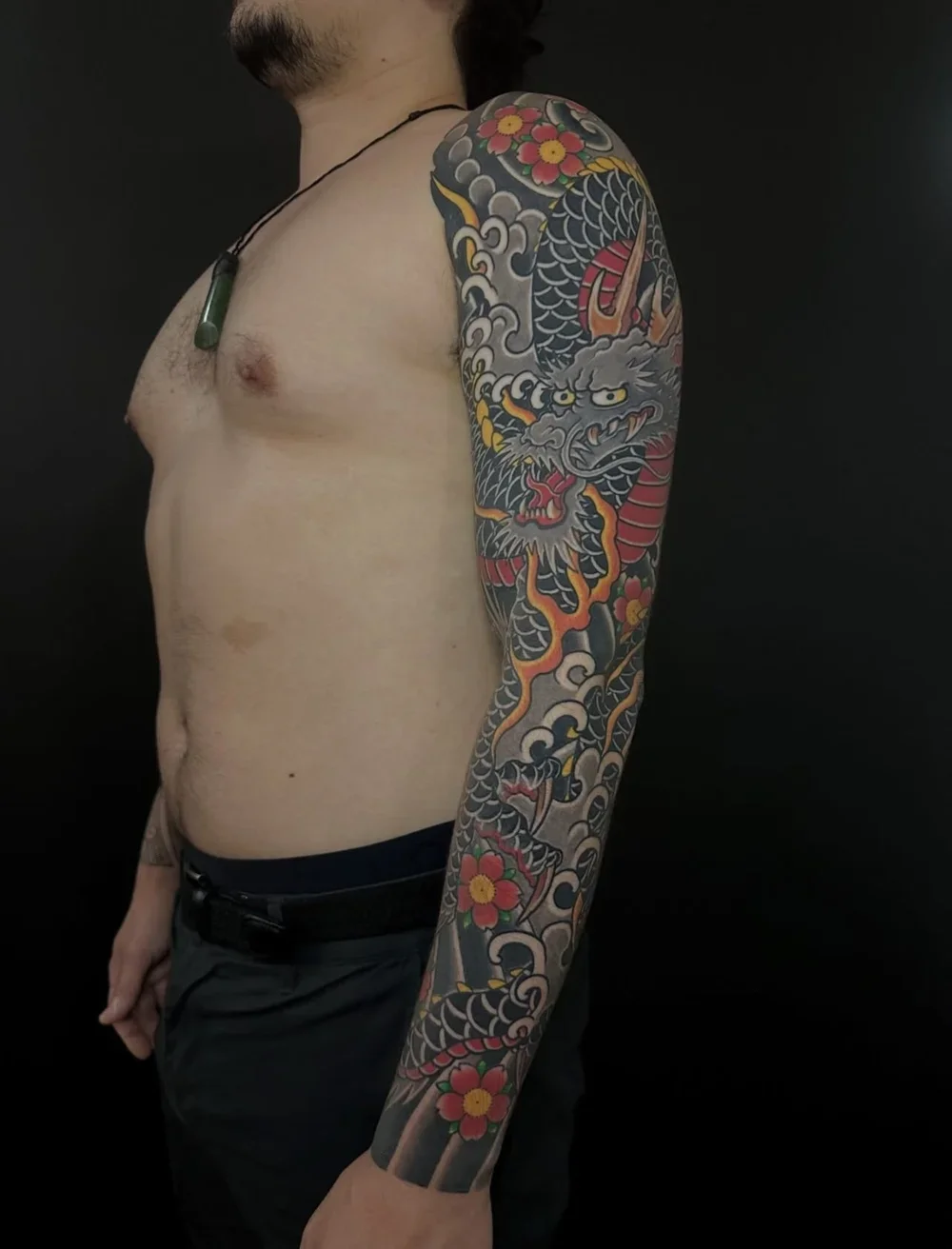
Dragon and Sakura Arm Sleeve
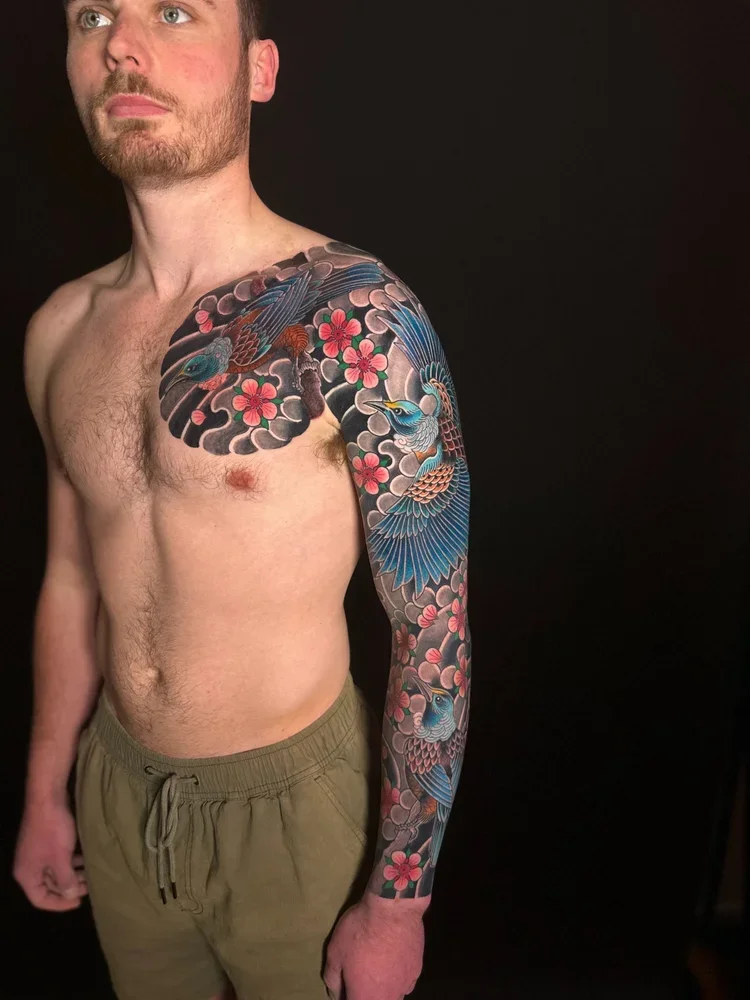
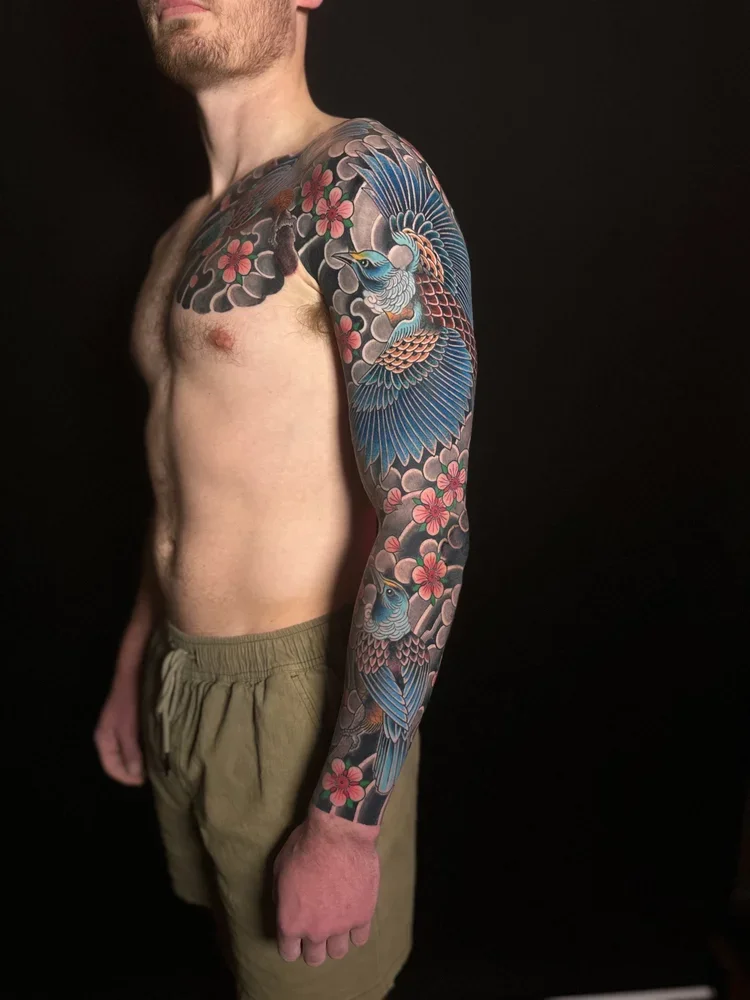
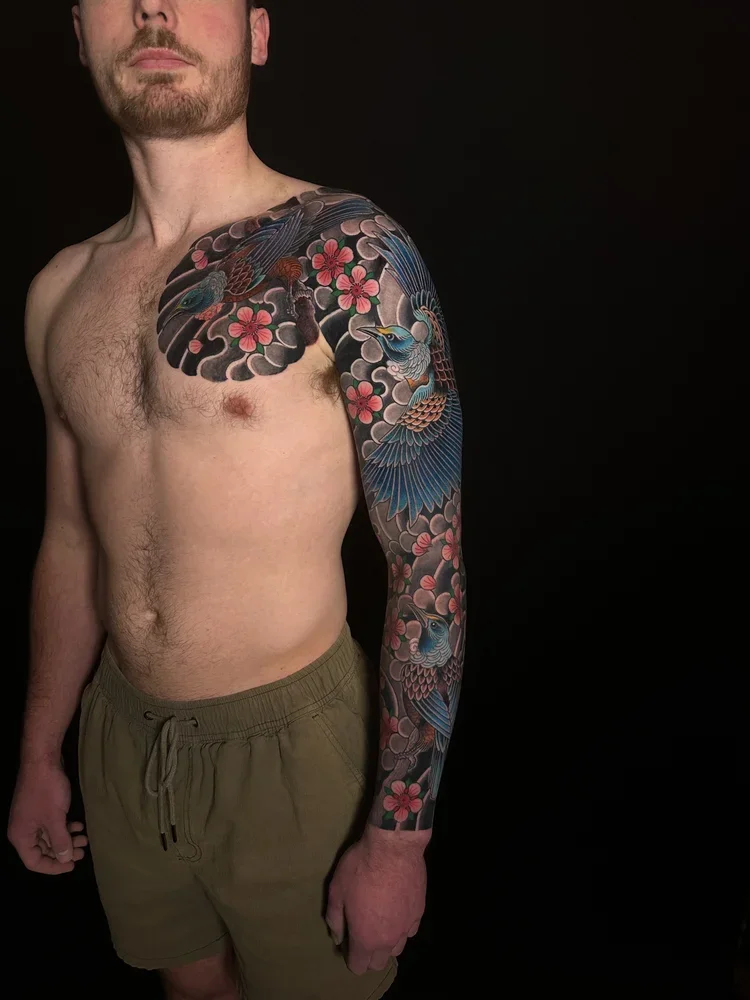
In traditional Japanese tattooing (irezumi), the dragon and sakura (cherry blossom) create one of the most meaningful design combinations. Together, they represent the balance between strength and impermanence.
The Japanese dragon (ryū) symbolises wisdom, protection, courage, and personal growth. Unlike Western dragons, Japanese dragons are seen as benevolent guardians connected to water and the natural world, making them powerful symbols of resilience and spiritual strength.
The sakura carries a very different meaning. Its short-lived bloom reminds us that life is beautiful but fleeting. Rooted in Buddhist philosophy, cherry blossoms represent the acceptance of change, the fragility of life, and living in the present.
Combined in a sleeve tattoo, these two elements create a striking contrast. The dragon represents enduring strength, while the falling cherry blossoms remind us that even the strongest things are subject to change. Together, they symbolise power balanced with humility and the beauty of embracing life's natural cycles.
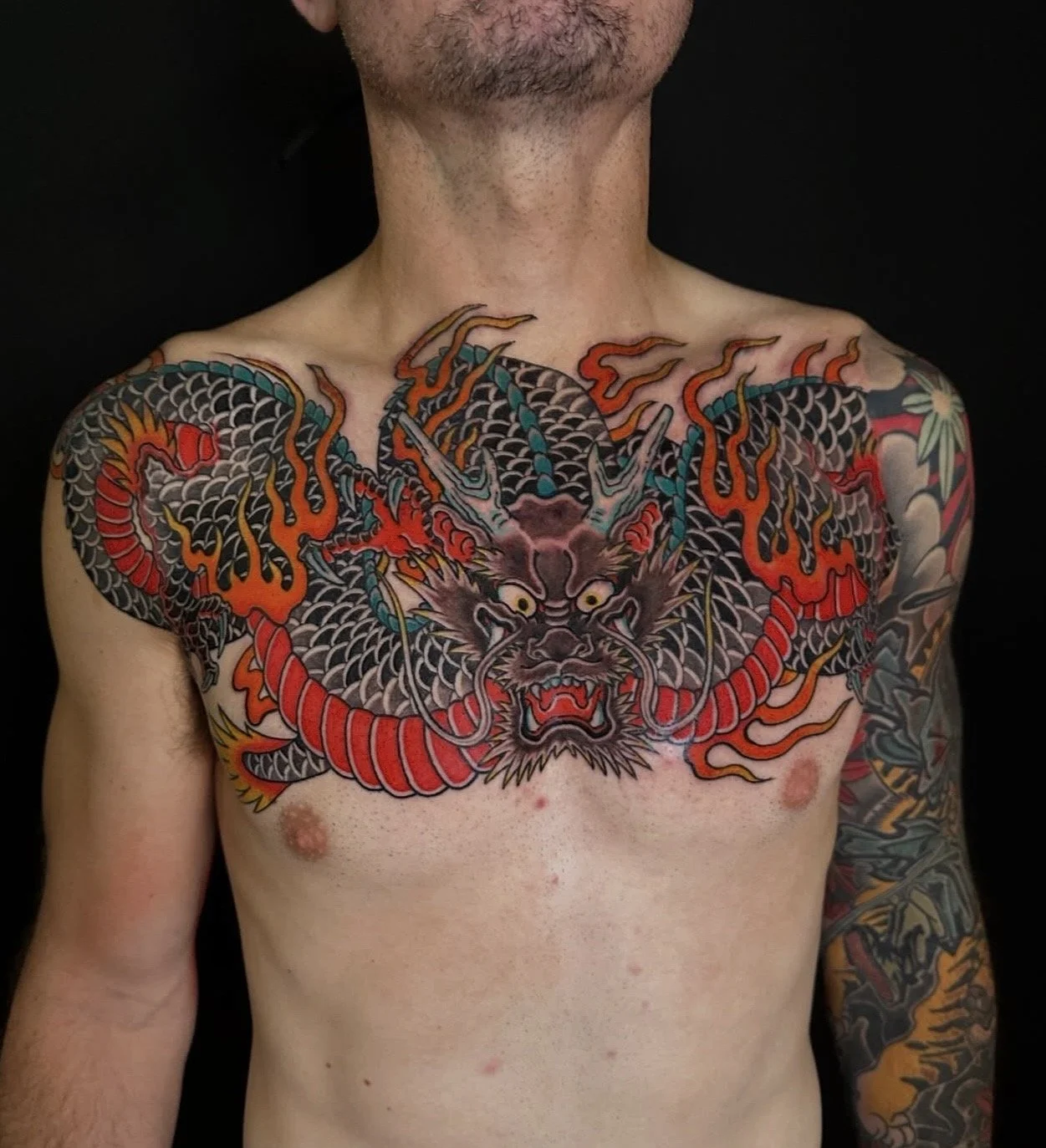
Dragon Chest Tattoo
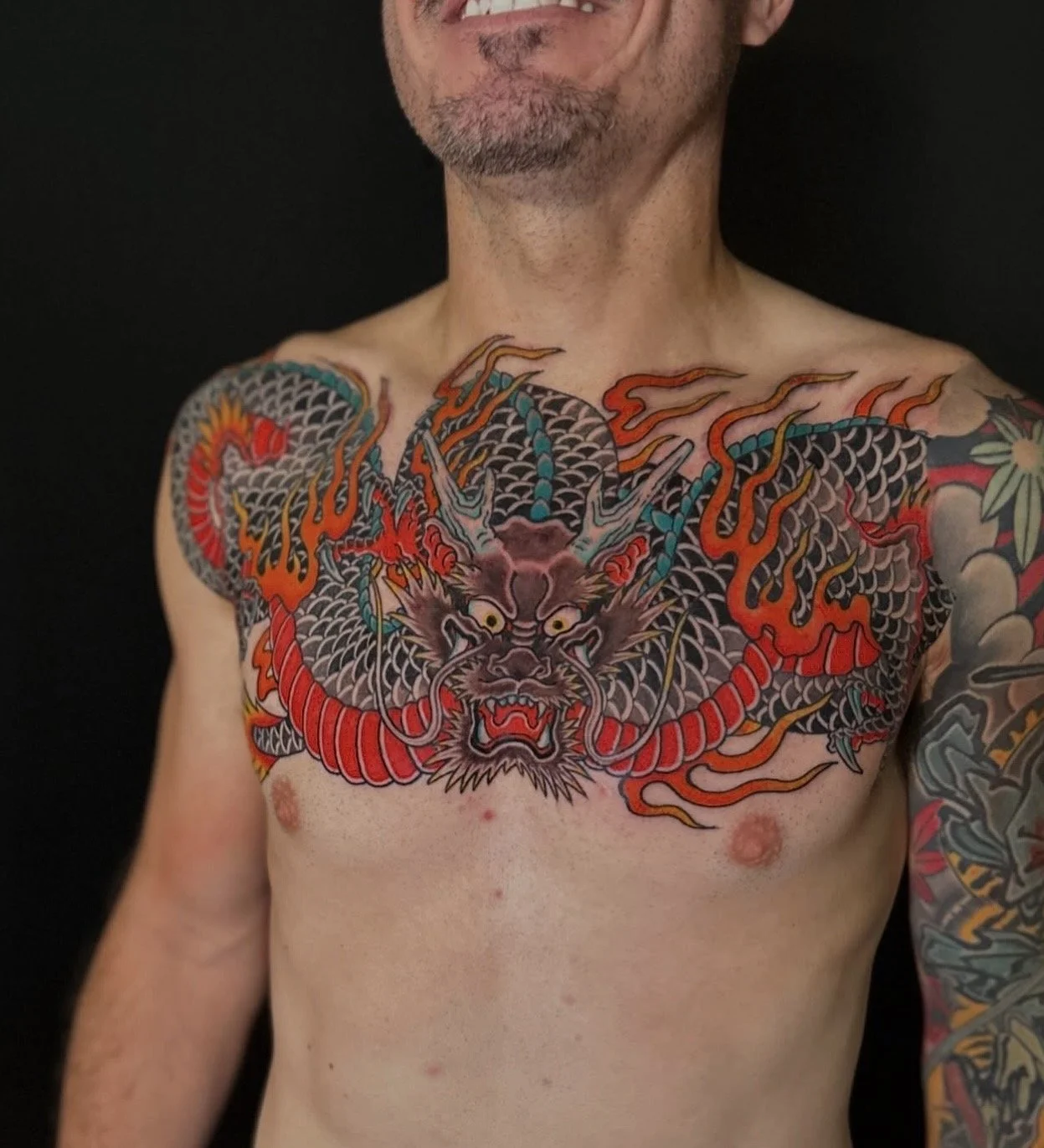
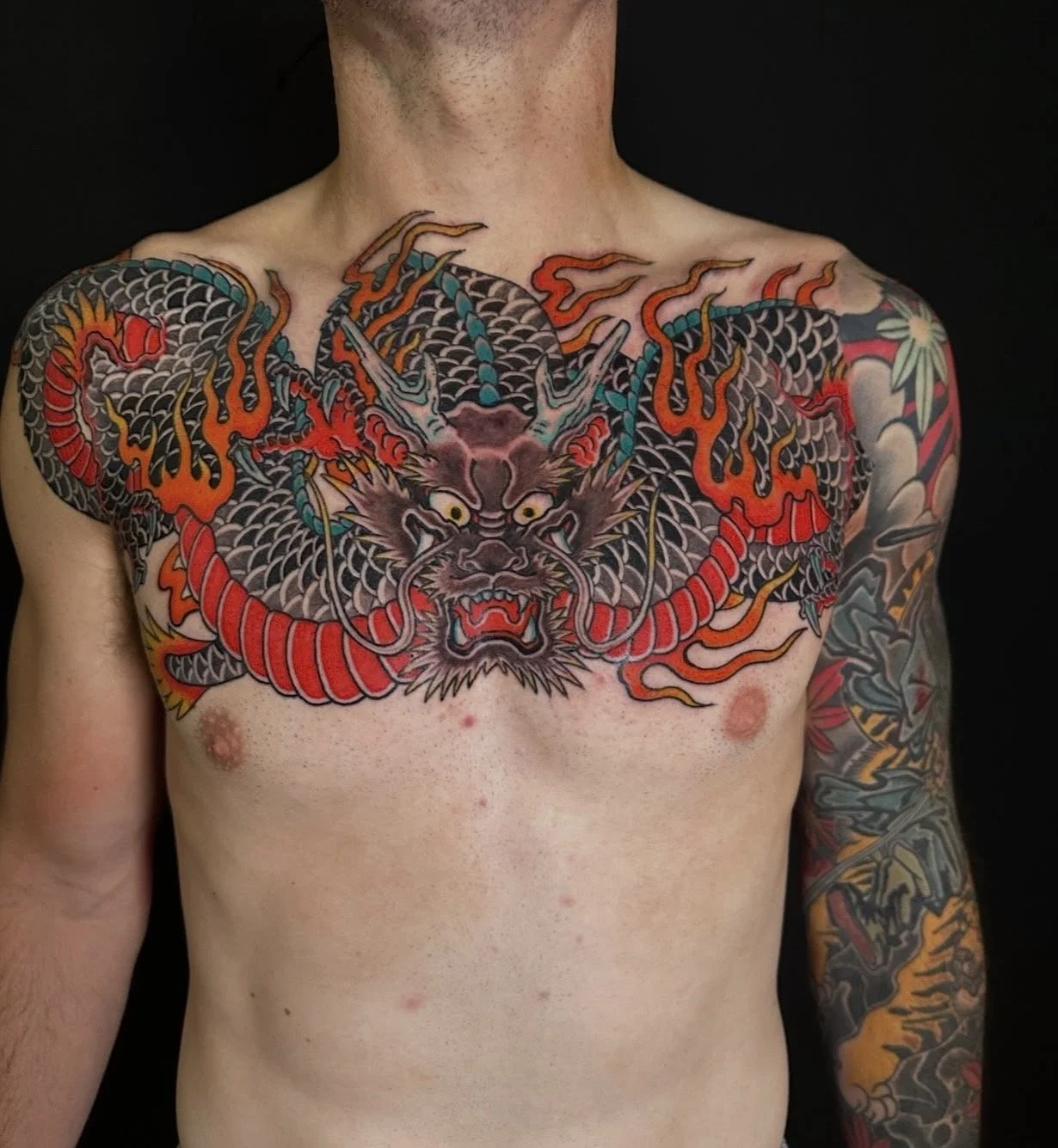
The chest is one of the most commanding placements for a Japanese dragon. It gives the piece room to breathe, the body can stretch across the collarbone, the head sits centred over the sternum, and the coils splay out toward the shoulders in a way that feels natural rather than forced.
The dragon here is a traditional Japanese ryū; not the winged Western kind, but the serpentine, cloud-dwelling creature that appears throughout Japanese art and mythology. The body coils from left shoulder to right, horns swept back, mouth open, whiskers flaring. The scales are packed tight across the upper chest, shaded dark with teal highlights that give the body dimension and movement. Beneath the scales, the underbelly runs red, which pulls the whole piece together and stops it from reading too dark.
Fire elements are woven through the composition; framing the body and filling the negative space between the coils. In Japanese tattooing this is a common pairing. Fire represents transformation, and the dragon is already a creature associated with power, wisdom, and elemental force. Together they reinforce each other without either element overpowering the piece.
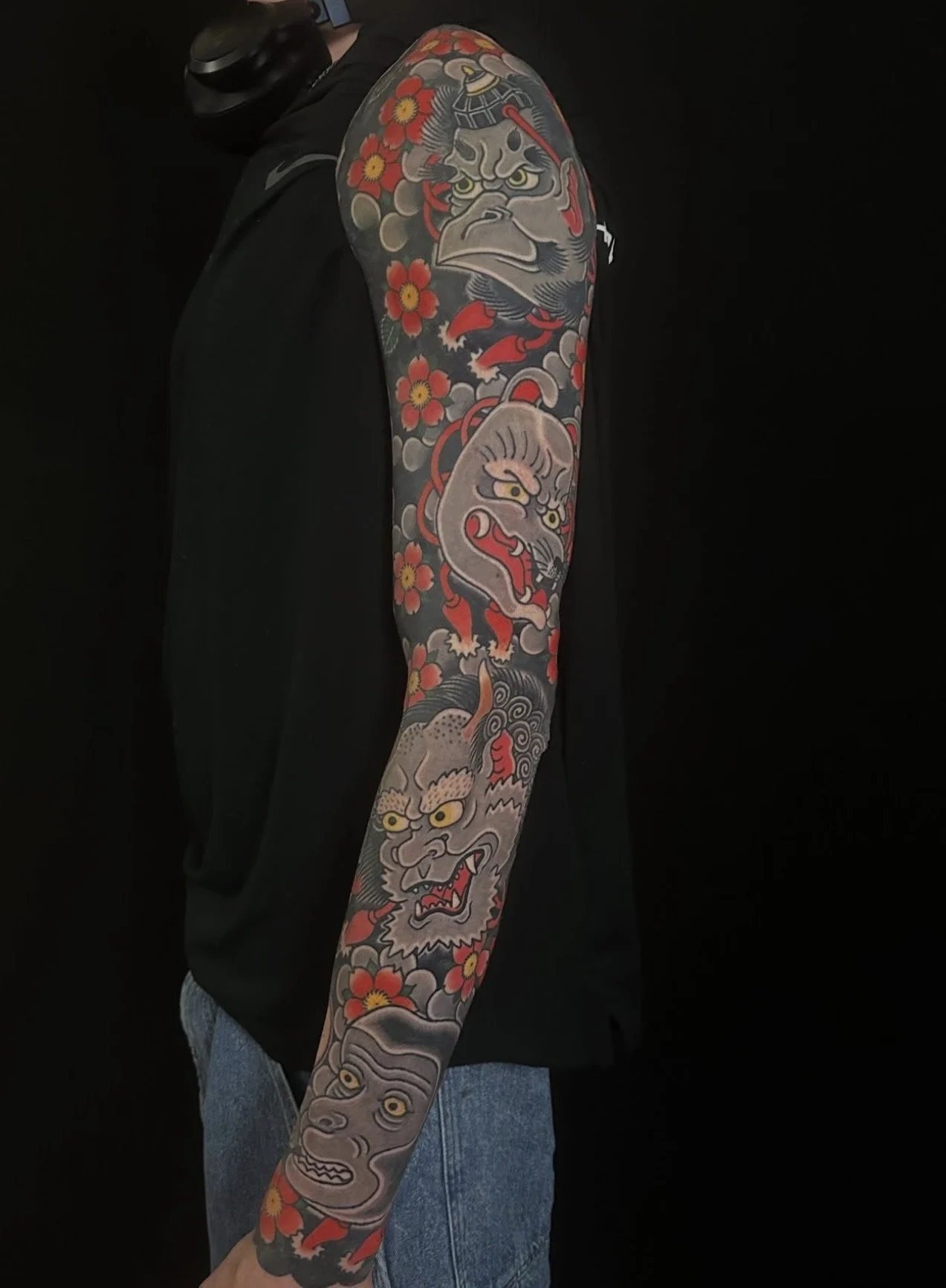
Japanese Mask Arm Sleeve
There's a reason masks hold such a powerful place in Japanese tattoo tradition. They don't just depict a character, they depict a role. Each mask carries centuries of folklore, theatre, and spiritual symbolism, and stacking them down the arm, as we've done in this sleeve, creates a kind of visual narrative as the eye travels from shoulder to wrist.
At the top sits the karasu tengu, the crow faced tengu, a mountain spirit and martial figure from Japanese folklore. Where the long nosed tengu is more closely tied to pride and humbling the arrogant, the karasu tengu carries a sharper, more bird like ferocity, often linked to swordsmanship and the supernatural training of warriors.
Below it, the kitsune, the fox. Foxes occupy a unique place in Japanese mythology as messengers of Inari, the deity of rice, prosperity, and fertility, but they're also famed shapeshifters capable of trickery and illusion. A kitsune mask carries that same duality, reverence and mischief in one face.
Further down the arm, the oni, perhaps the most iconic of all Japanese demons. Oni are powerful, often monstrous figures associated with strength, chaos, and protection in equal measure. In tattoo work, oni masks are popular for their raw intensity, while also symbolising the wearer's own strength in overcoming hardship.
And finally, at the wrist, the saru, the monkey. Less overtly fearsome than the masks above it, the saru carries its own rich symbolism in Japanese culture, tied to cleverness, mischief, and in some traditions, protection against illness and misfortune. It's a fitting close to the sleeve, a touch of wit and warmth to balance the intensity higher up the arm.
Threading through all four masks are cherry blossoms, a classic pairing in Irezumi work. Where the masks bring weight and folklore, the sakura bring softness and impermanence, a reminder that nothing, not even demons and fox spirits, lasts forever.
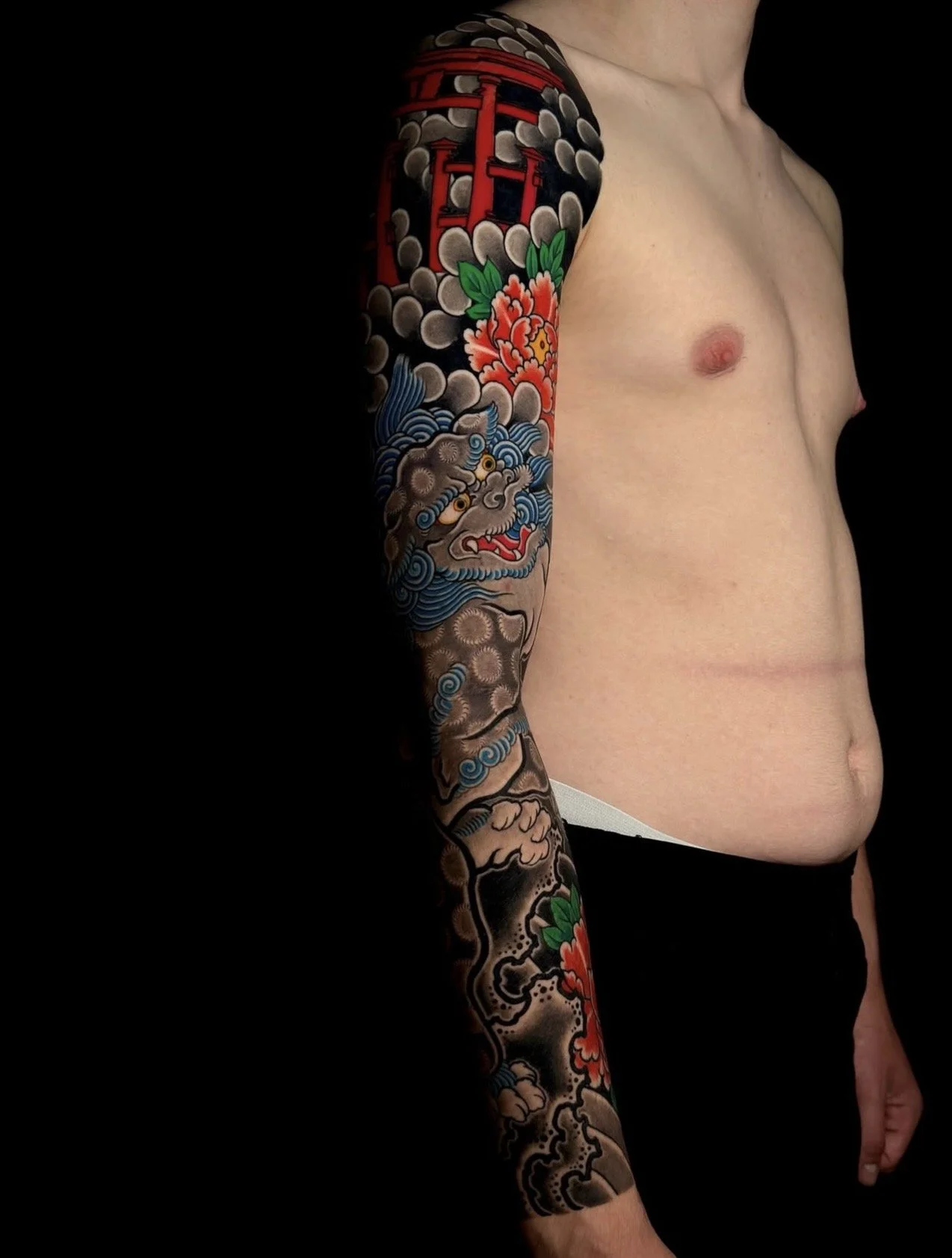
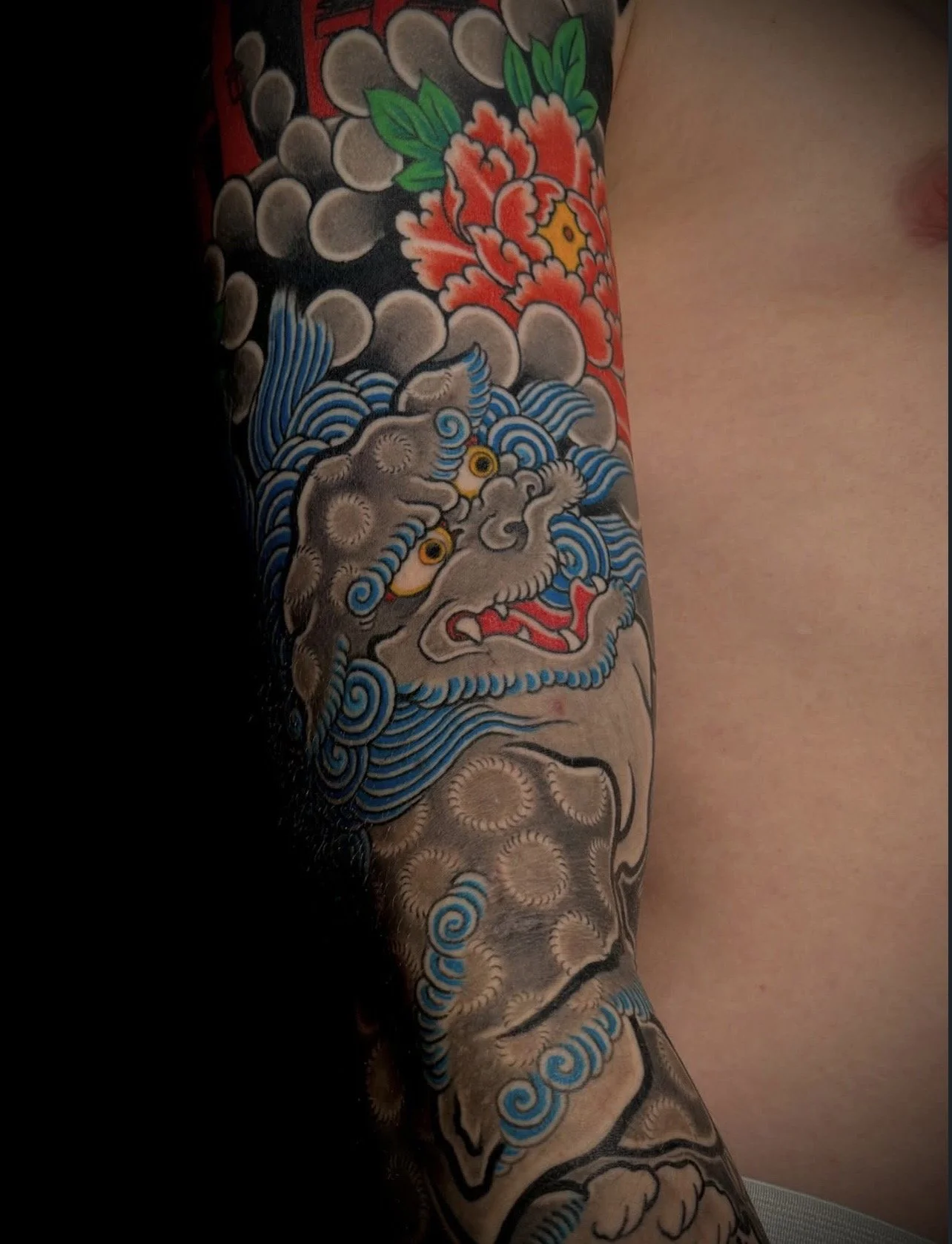
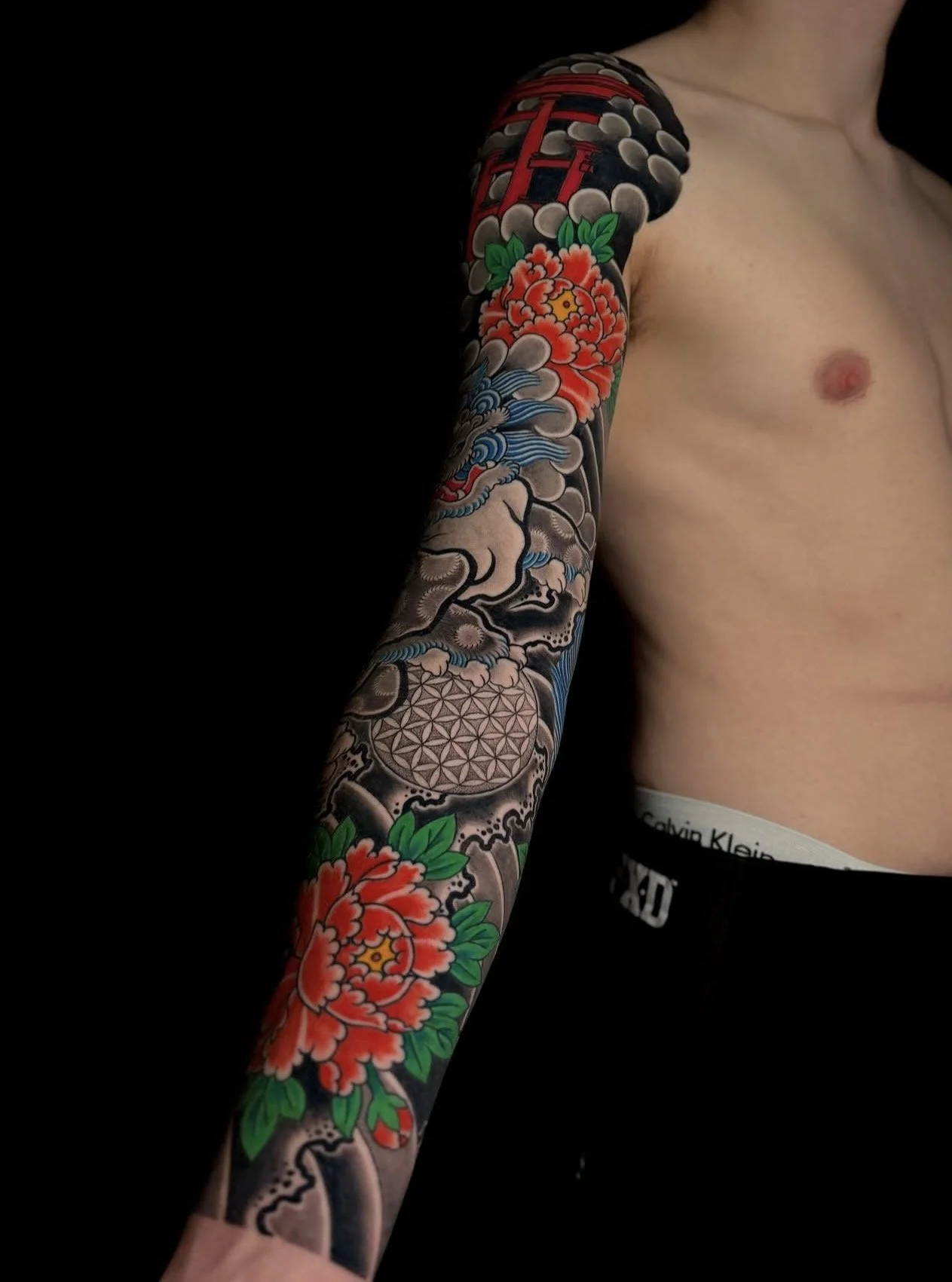
Fu Dog, Shrine and Peony Arm Sleeve
This striking Japanese arm sleeve blends power, protection, and beauty into one cohesive design. The centrepiece of the tattoo is the fierce fu dog, a traditional symbol of strength and guardianship. Surrounded by flowing waves and textured stone shading, the fu dog gives the sleeve a bold and dynamic energy.
Bright peonies add contrast and balance throughout the piece. In Japanese tattoo culture, peonies represent prosperity, courage, and elegance, making them the perfect complement to the intensity of the guardian figure. Their vibrant reds and greens stand out against the dark background, creating strong visual depth.
At the shoulder, the red shrine gate adds a spiritual element to the composition. Often associated with sacred spaces and personal journeys, the gate helps frame the entire sleeve while tying together the traditional Japanese aesthetic.
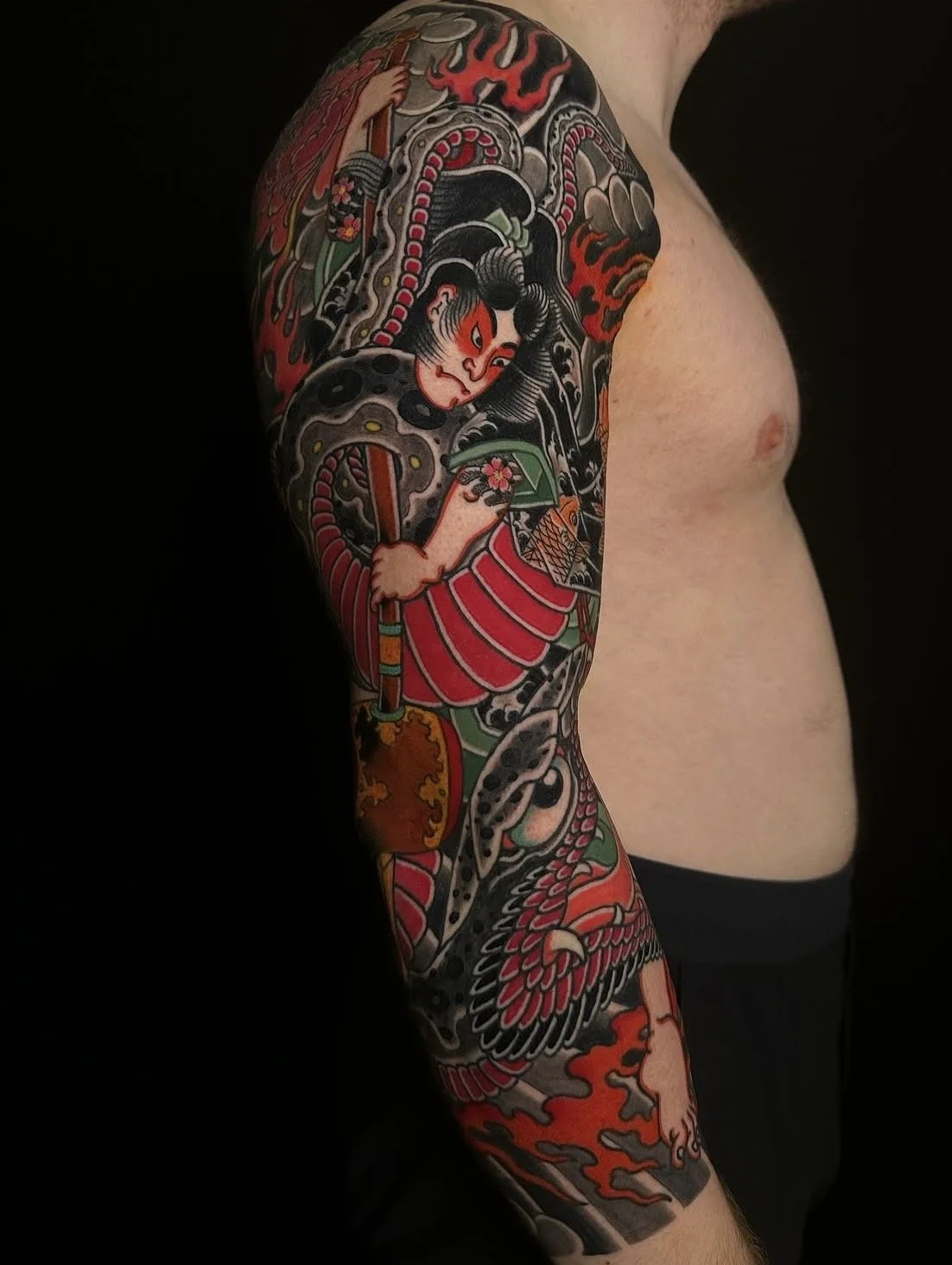
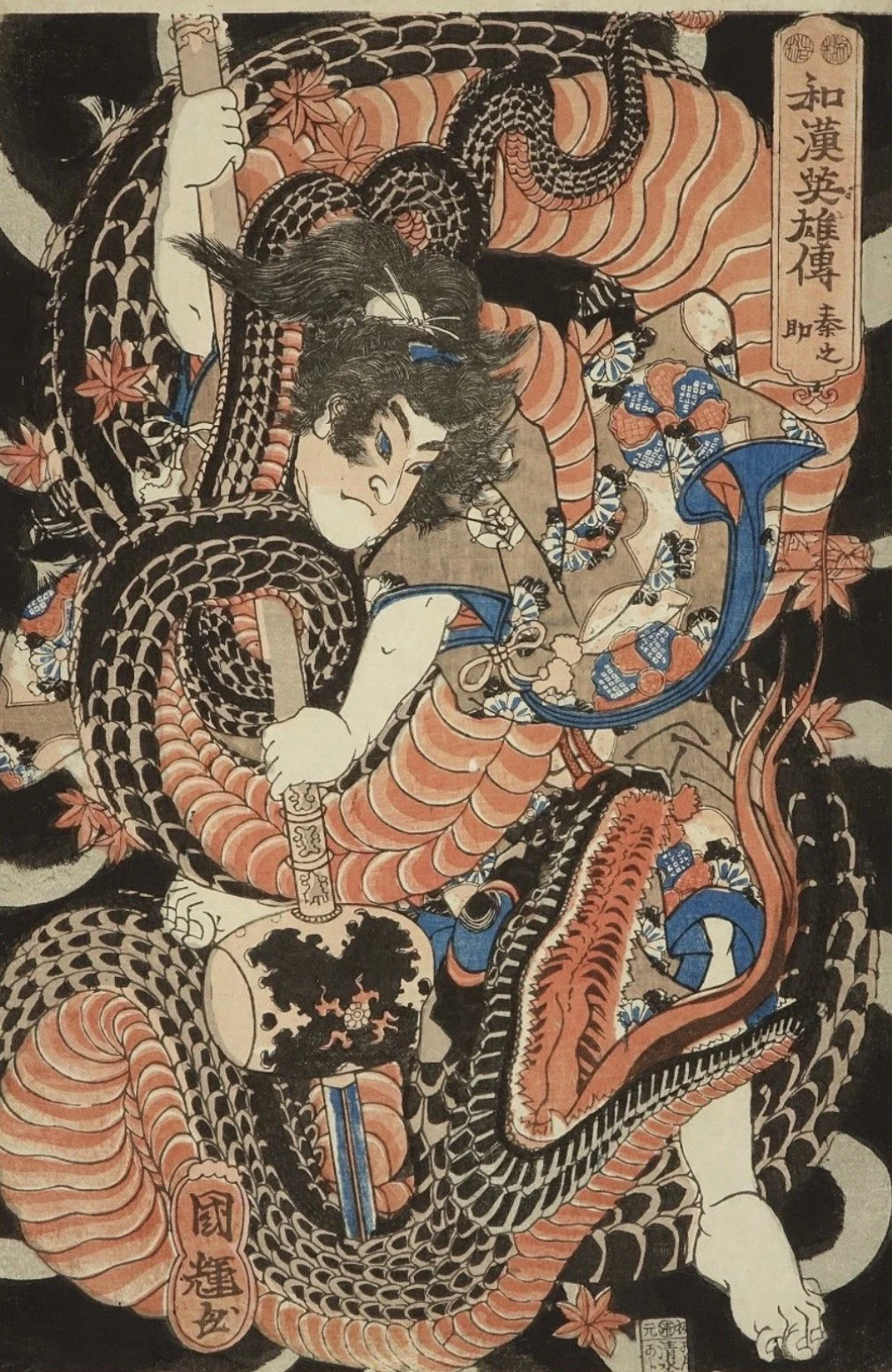
Tainosuke Slaying a Serpent
The legendary battle of Tainosuke slaying a serpent makes a striking motif for a Japanese-style arm sleeve tattoo. Immortalised by Utagawa Kuniteru I in his 1840s series Wakan eiyū den (Heroes of Japan and China), this scene blends myth, drama, and dynamic movement, perfect for a flowing, full-arm design.
In tattoo form, the twisting serpent can wrap around the arm, creating natural curves, while Tainosuke’s heroic stance anchors the composition. The contrast of bold lines, swirling patterns, and negative space, hallmarks of ukiyo-e, translates beautifully to skin, giving the piece energy and narrative depth.
A sleeve inspired by this print not only captures action and courage but also honors traditional Japanese art. Every coil of the serpent and every strike of Tainosuke’s weapon becomes part of a living story on the wearer’s arm, an eternal battle frozen in dramatic motion.
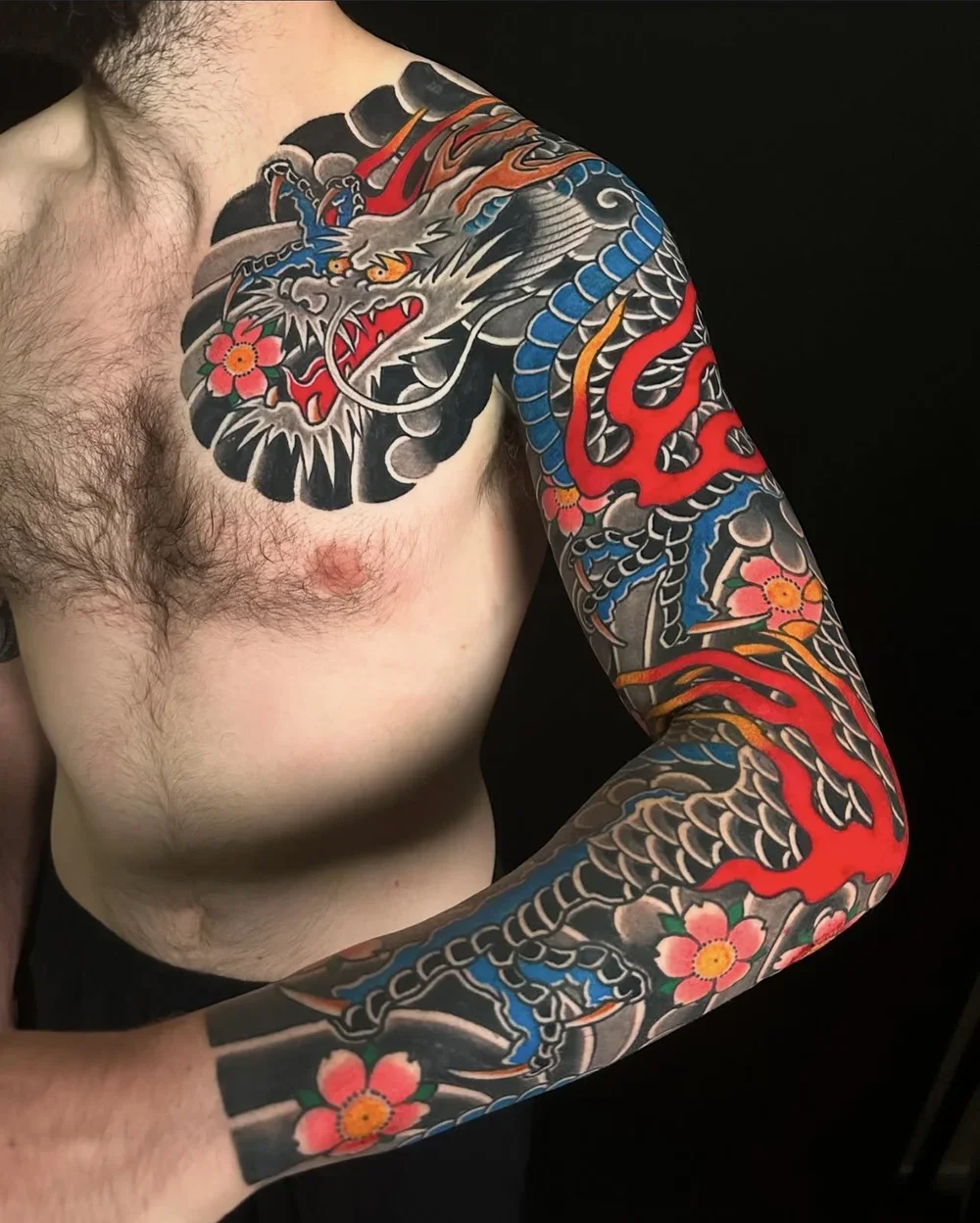
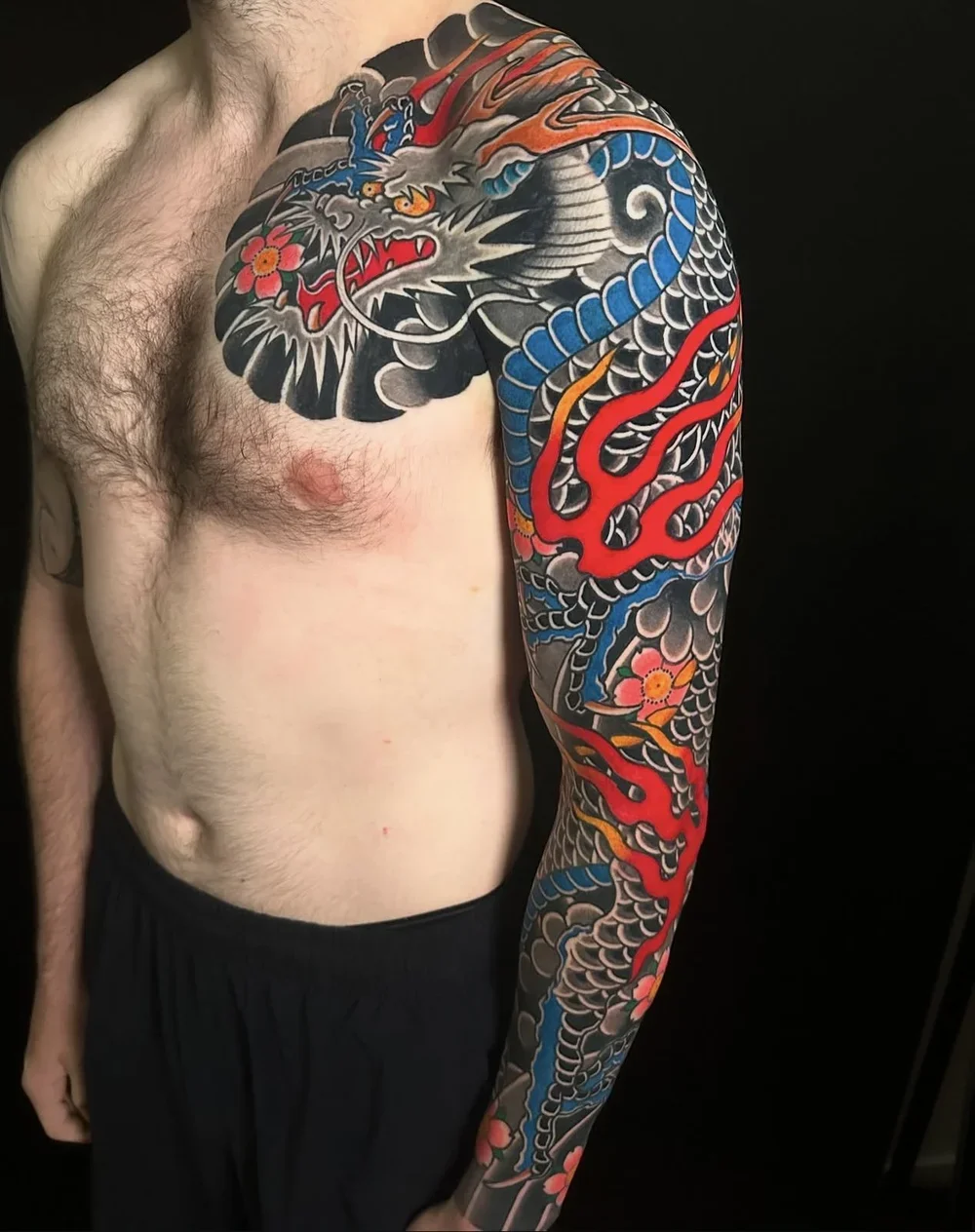
Dragon and Sakura Arm Sleeve with Chest Plate
A Japanese dragon and sakura tattoo is a striking design rich in symbolism, blending strength and the fleeting beauty of life.
In Japanese culture, dragons are mystical guardians, representing wisdom, protection, and resilience. Unlike Western dragons, they are seen as benevolent, often twisting around the body to create dynamic movement and flow. Sakura, or cherry blossoms, bloom briefly each spring, symbolizing life’s impermanence and reminding us to cherish fleeting moments. When paired with a dragon, sakura softens its fierce energy, creating a balance between power and fragility.
A full arm sleeve with a chest plate is an ideal canvas. The dragon can coil from wrist to shoulder, while sakura blossoms flow naturally around it. This arrangement emphasises the dragon’s protective strength, complemented by the delicate beauty of the flowers.
Traditional Japanese tattoos use bold lines and vibrant colours, deep blues, greens, and blacks for the dragon, with pinks and whites for sakura. The contrast highlights both the dragon’s power and the blossoms’ softness, resulting in a design that is visually striking and timeless.
Fisherman and Koi Arm Sleeve
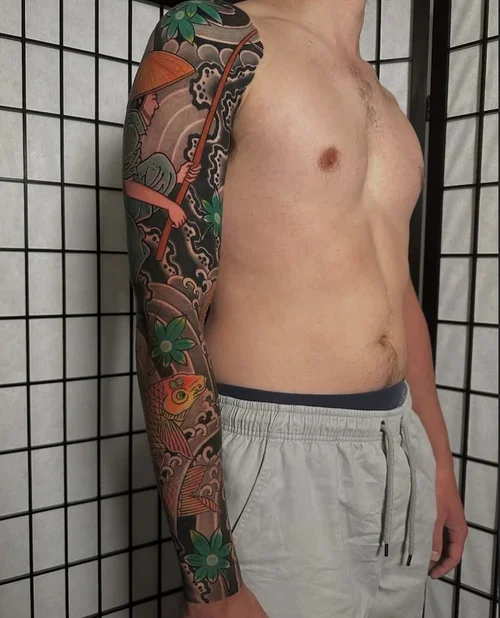
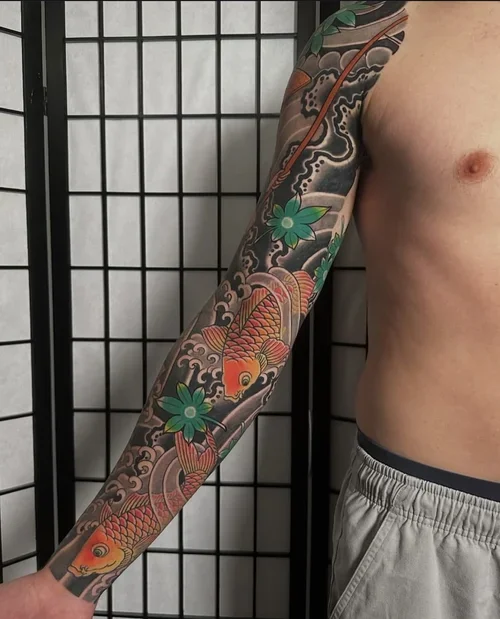
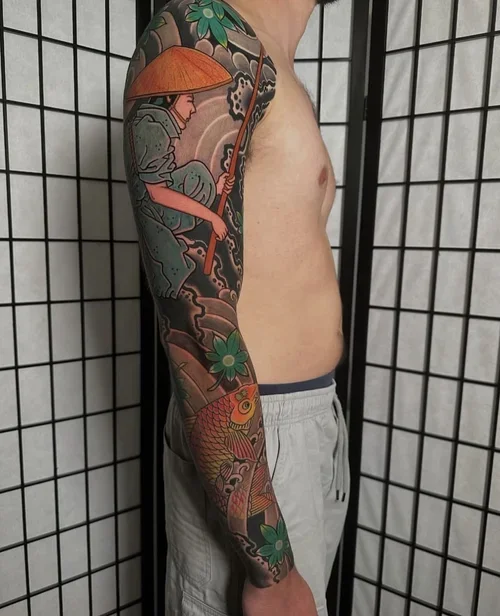
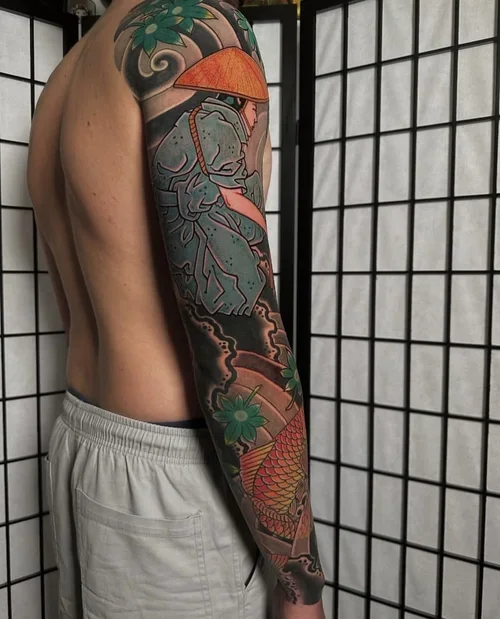
The koi fish is a well-known symbol in Japanese culture, commonly associated with strength, perseverance, and determination. It represents the ability to overcome challenges and develop resilience through adversity. In Japanese legend, a koi that swims upstream and climbs a waterfall is said to transform into a dragon, symbolising achievement, resilience, and personal growth. In tattoo designs, the koi often reflects the wearer’s own experiences of persistence and their drive to succeed despite obstacles.
The fisherman in this design represents patience, focus, and discipline. Fishing, particularly in quiet natural environments, requires concentration and a steady mindset. The fisherman standing on the rocks symbolises someone who is grounded and composed, willing to wait for the right moment while staying focused on their objectives over time.
Together, these elements create a balanced composition. The movement of the koi reflects struggle and effort, while the fisherman represents the calm, controlled approach needed to manage challenges. The design highlights the balance between action and restraint, and the importance of persistence paired with patience.
Geisha Arm Sleeve
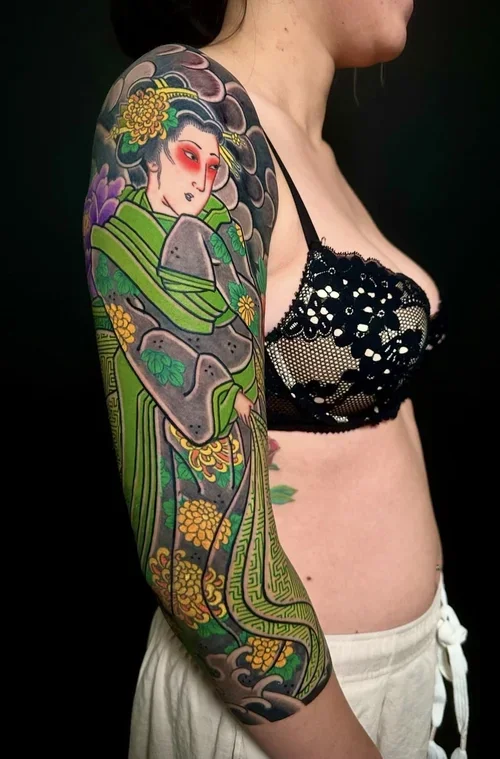
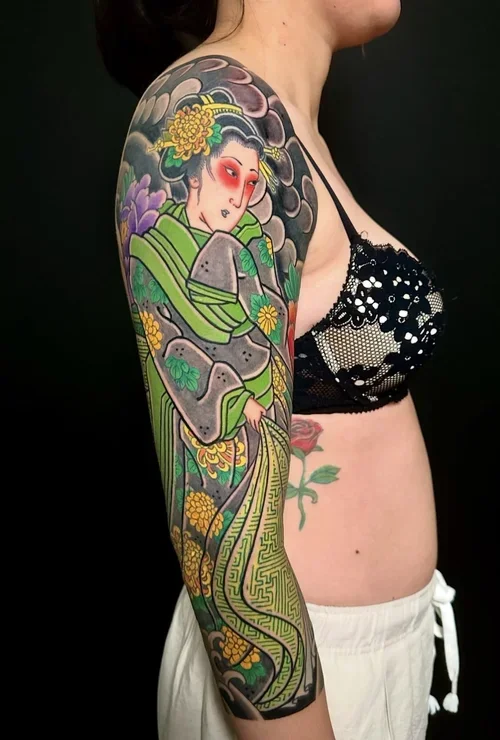
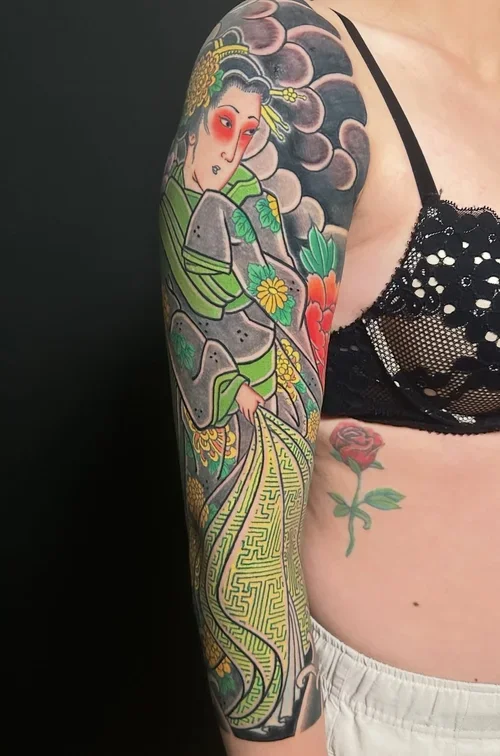
The geisha represents poise, discipline, and inner strength, and serves as the central figure in this tattoo. Her kimono and headpiece are carefully detailed with chrysanthemums, flowers traditionally associated with longevity, honour, and renewal. The geisha’s calm expression and composed posture emphasise restraint, resilience, and a lifelong commitment to mastery.
Chrysanthemums add symbolic depth to the design, reinforcing themes of personal growth and endurance. Behind her, peonies fill the background with structure and weight. Often referred to as the “King of Flowers,” peonies symbolise prosperity, vitality, and respect, providing a strong visual counterbalance to the geisha’s reserved presence.
The composition relies on bold colour and controlled movement rather than ornamentation. Golden tones in the chrysanthemums contrast with the deeper reds and muted pinks of the peonies, while the geisha’s form anchors the design. The three-quarter sleeve layout allows the elements to flow naturally along the arm, creating cohesion without excess.
Though rooted in traditional imagery, the tattoo can hold personal meaning. The geisha may represent discipline or influence, while the flowers can reflect growth through experience. Together, the design communicates strength, perseverance, and quiet confidence.
Dragon Back Piece
A full-back Japanese tattoo is one of the most powerful and meaningful forms of body art. One of the most iconic designs features a dragon; symbolising strength, wisdom, and protection, paired with sakura (cherry blossoms), which introduce themes of beauty and impermanence.
Traditionally, the dragon’s long, serpentine body coils across the back, with its face centred along the spine to create balance and a strong focal point. Rendered in classic Japanese style, the dragon appears dynamic and fierce, detailed with flowing scales and claws. Sakura blossoms or drifting petals are woven through the background, adding movement and softening the dragon’s intensity.
In Japanese culture, dragons are noble, protective beings connected to water and natural forces. Sakura, by contrast, represent the fleeting nature of life. Together, they express a balance between enduring strength and the awareness of life’s transience.
These tattoos are typically done in the irezumi style, using bold lines, rich shading, and traditional colours. Due to their scale and detail, they require multiple sessions and a serious commitment, often chosen by those with deep respect for the art and its symbolism.